
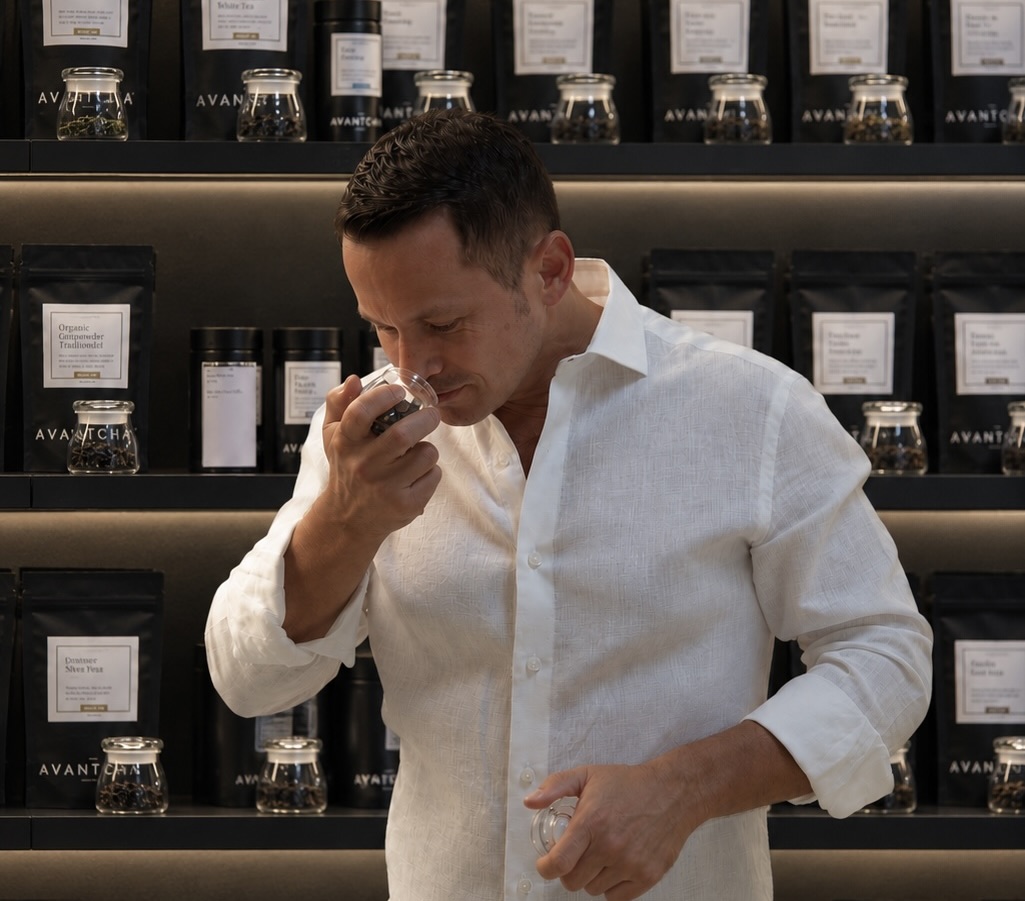
Some of Christian Lehmann's best ideas for tea blends arrive when he's nowhere near a cup of tea.
They might come to him while swimming, out for a run, or simply during one of those moments when there's enough room in his head to think about something other than the day ahead.
Chris loves cooking, and as it turns out, creating a tea blend isn't so different from developing a recipe in the kitchen. Both begin with an idea of how something should taste, followed by a mental exercise in working out which ingredients might bring it to life.
"It's a process in my head first," he explains. "When the mind is free from everything else, then you can think of what flavours, what combinations could work."
Before he reaches for a single ingredient, he's already imagining the flavours, their proportions and how they might work together. Of course, there's a practical side to all this.
"There are certain things that we can't put in tea, because it wouldn't work." Some ingredients are difficult to source, others simply don't exist in a suitable dried form.
An idea might sound wonderful in theory, but getting it into a cup is another matter entirely.
A Question of Balance
Once there's a direction in mind, the real experimentation begins.
Rather than immediately mixing together a collection of dried leaves, fruits, herbs and spices, Chris will sometimes brew the ingredients individually and start combining the resulting infusions. It's a clever way of working, allowing him to adjust the proportions, add a little more of one flavour or pull back on another, without having to remake the entire blend each time.
And those small adjustments can make an enormous difference.
"You always have ingredients that either you want to highlight or you want to balance out," he explains. "Especially spices, you don't want one particular spice to overpower everything."
Take Organic Masala Spice Chai, for example. Clove is one of its most powerful ingredients, capable of dominating the entire cup even when it makes up only a small percentage of the recipe. Too much, and the other spices disappear behind it. Too little, and something important is missing.
Finding the right balance means understanding not just what each ingredient tastes like, but how it behaves alongside everything else.
Sometimes the first attempt is the one. Other blends might need three, four or five rounds before everyone is satisfied.
With experience comes a good instinct for proportions, and occasionally the version that felt most promising from the beginning turns out to be the winner after all. He recalls a recent Turmeric & Tangerine (not yet launched) blend where, despite experimenting with a second version featuring less cardamom and mandarin flavour, the team ultimately chose his original recipe.
"I was actually sure that the first one would work," he admits.
But arriving at a delicious blend is only half the story.
How to Maintain Consistent Flavour in Tea Blends
Perhaps the most interesting part of our conversation was discovering that creating something new isn't necessarily the hardest part of the work. Making sure it continues to taste the same, year after year, can be considerably more challenging.
"Creating is one thing," Chris explains, before describing the difficulty of maintaining a consistent flavour profile over time. "I think this is most likely the biggest challenge because you have to balance out the seasonality and the different harvests of the teas, but then also the ingredients."
Tea is an agricultural product, and so are many of the ingredients that go into a blend. Each harvest brings its own subtle variations, influenced by growing conditions, seasonality and the natural character of the plants.
"Sometimes we have orange peel that is very zesty and sweet, and then sometimes we get orange peel that is bitter and astringent."
Mint can be equally unpredictable.
"Moroccan Mint is always a challenge," he tells us. It's a blend that needs to be revisited with each production, adjusting ingredient proportions to ensure the familiar flavour remains intact.
Chris likens the process to making non-vintage Champagne, where a master blender works with wines from different years to maintain a recognisable house style.
"The master blender's responsibility is to always keep the same profile from production to production. And that's a challenge because it's a natural product, and the natural product changes from year to year, even from season to season."
It's an interesting comparison. We tend to think about the creativity involved in making something new, but there's an entirely different skill in recreating something familiar using ingredients that are never quite identical.
The responsibility is to work with those natural variations while preserving the character of the tea people know and love.
The Pleasure of Making Something New
For all the technical considerations, there's a wonderfully simple reason Chris enjoys developing blends: he loves experimenting with flavours.
"If the timeline is long enough, I usually get excited because I have time to think about it."
A short deadline is less appealing, mostly because it leaves little opportunity for that creative process to unfold. But once he's standing at the blending counter, surrounded by ingredients, the enthusiasm returns.
"This is what I love about these projects. The flavour combinations, and same with cooking."
It's the pleasure of taking different elements, bringing them together and discovering that they can become something quite different from what they were individually.
And, rather charmingly, he prefers to do this when everyone else has gone home.
"Usually this is best when everyone has left and I have the space for myself," he explains, describing how much he enjoys being able to concentrate on the ingredients in front of him without any interruptions.
It's a reminder that behind a tea we might brew without a second thought, there's often a great deal of imagination, experimentation and careful adjustment.
A little more of this. A little less of that. Another taste, another adjustment, until everything falls into place.
And then, of course, the next harvest comes along, and the work begins again.
 All Rights Reserved. © AVANTCHA 2026