
What is Matcha? How It's Made, What It Tastes Like, and How to Choose One
Few ingredients carry a thousand years of culture into a single cup. Matcha, the vivid emerald powder that began in the discipline of Japanese tea ceremonies and has since moved into the morning rituals of millions worldwide, is a history lesson, a flavour experience, and one of the most technically demanding things a tea farmer can produce.
Today it is everywhere: on café menus in Dubai and Tokyo, in the kitchens of pastry chefs and mixologists, in the routines of people looking for something more grounded than coffee. Yet its ubiquity has not made it better understood. Matcha is routinely confused with green tea powder, reduced to a flavour profile, or chosen without any knowledge of what separates a bowl worth drinking from one that isn't.
This guide covers what matcha is, how it is made, what it tastes like, and how to choose one.
.jpg?w=2000&h=1600)
What Is Matcha?
Matcha (抹茶) is a Japanese green tea made from shade-grown tencha leaves, selected from the earliest flush of spring, then steamed, dried, de-stemmed, de-veined, and slowly stone-ground into an ultra-fine powder. Because the entire leaf is consumed rather than steeped and discarded, a bowl of matcha delivers a more concentrated intake of the leaf's compounds than any infused tea can.
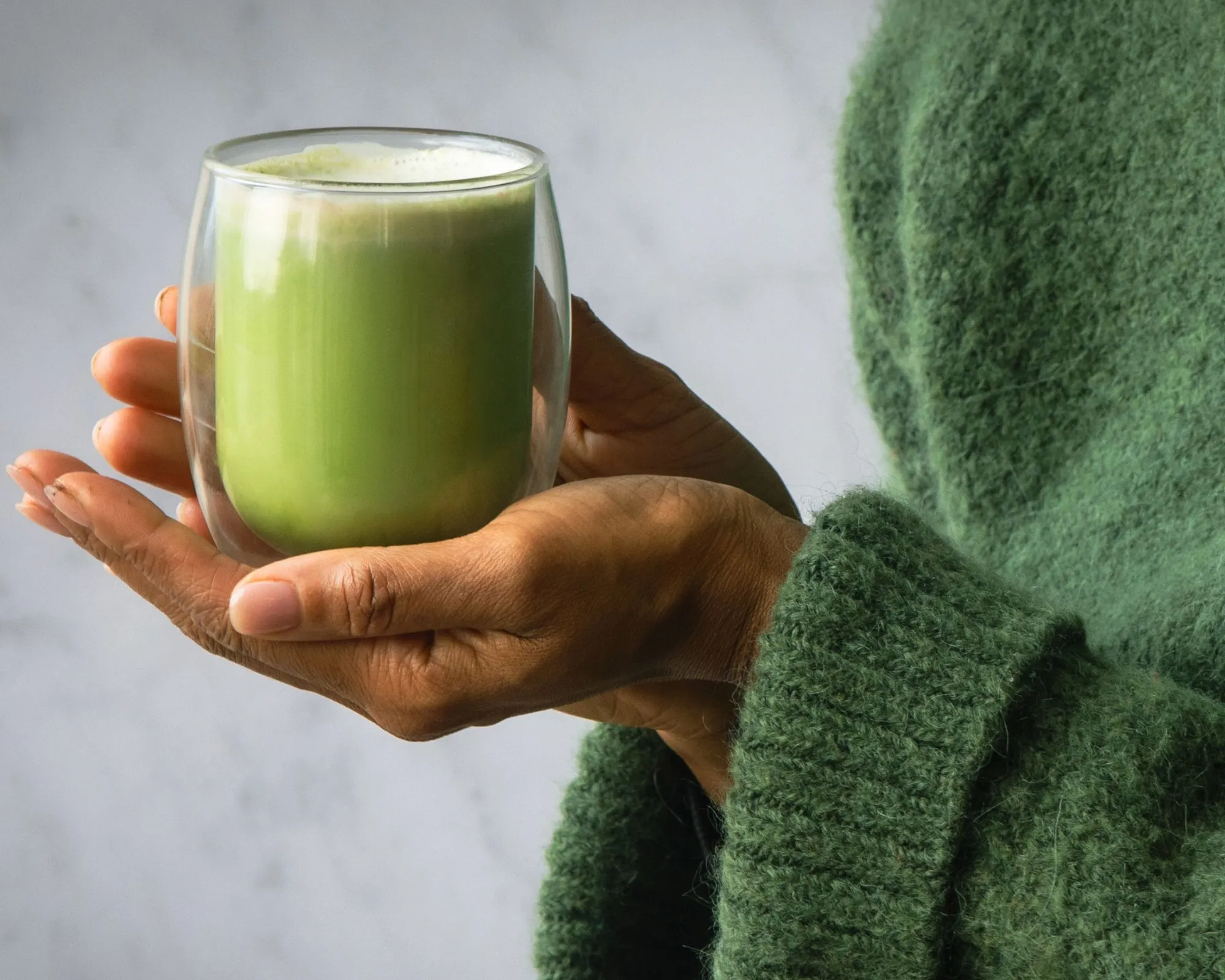
Beyond its traditional preparation with water, matcha has found a place in modern kitchens as an ingredient in chocolates, confectionery, baked goods, and latte-style drinks. For general applications, a culinary grade matcha is typically chosen for its ability to hold its character against other flavours.
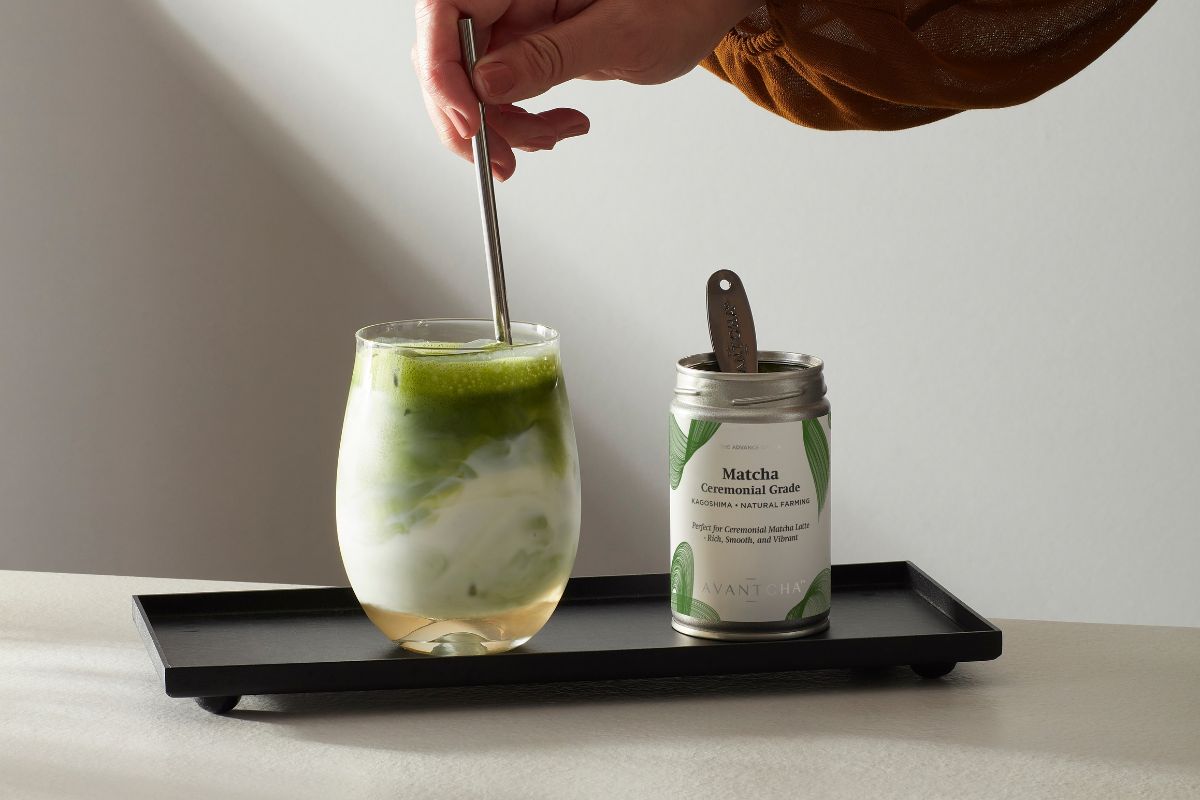
Our Ceremonial Grade Kagoshima, a blend of first-harvest Yabukita, Okumidori, Okuyutaka, and Zairai cultivars grown in volcanic soil in Kagoshima and stone-milled to order, was developed with precisely this in mind but for more premium creations: the balance of sweetness and intensity that performs against milk, milk alternatives, and cocktail ingredients the way a good ristretto performs in a flat white.
.jpg?w=2000&h=1600)
A Brief History of Matcha
Matcha's origins lie in Tang Dynasty China (618–907 CE), where the practice of grinding tea leaves into powder and whisking them with water first emerged. It arrived in Japan in the 12th century, brought by the Zen monk Eisai (明菴栄西, 1141–1215), and over the following centuries became inseparable from Japanese tea culture. By the 15th century, the formal tea ceremony had taken shape around it. Shading techniques were developed to enhance the leaf's chlorophyll and deepen its umami. Stone milling became the standard method for achieving the powder's characteristic fineness. The matcha in your bowl today is the product of roughly nine hundred years of accumulated refinement.
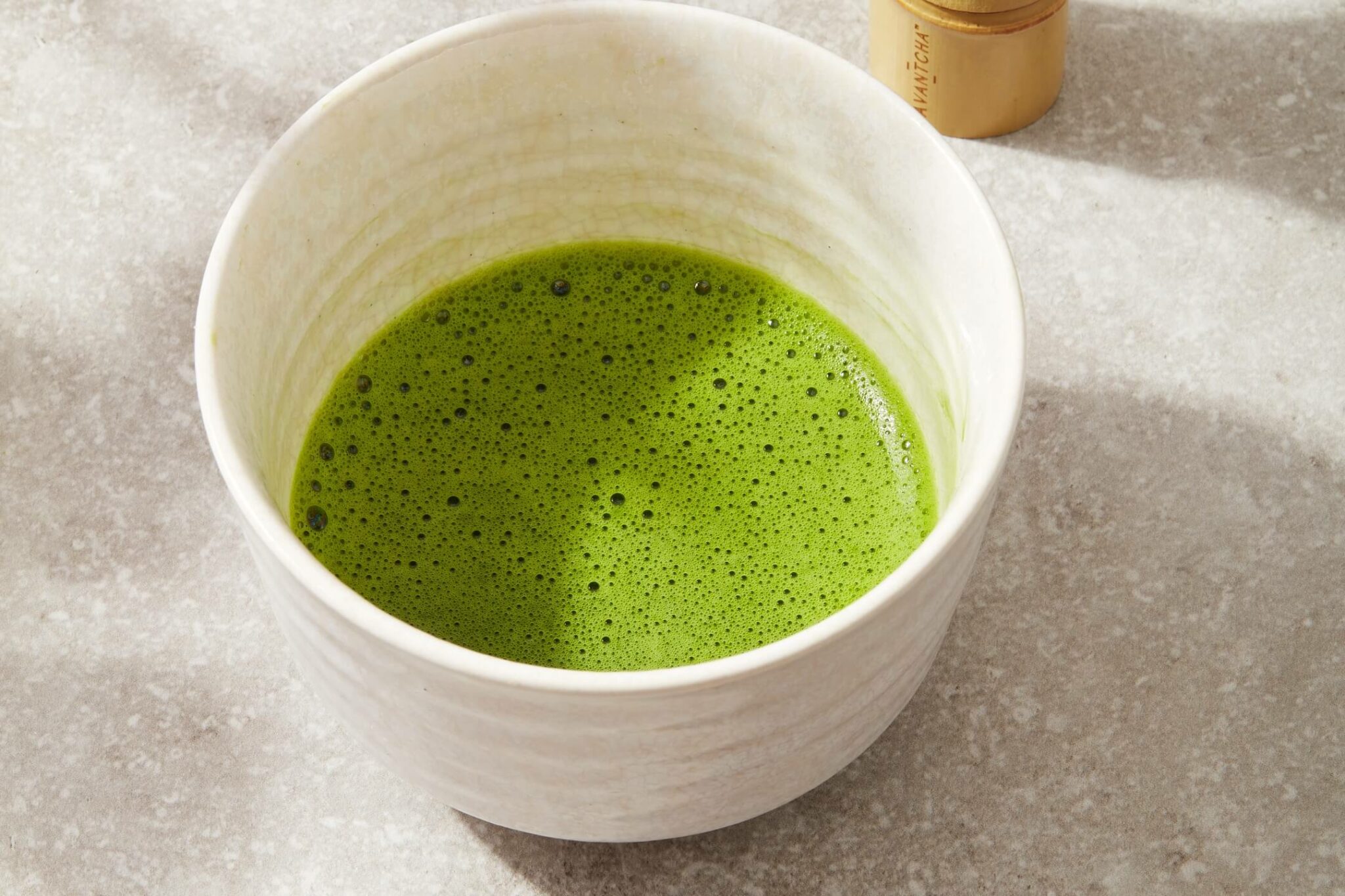
Japanese Matcha Ceremony
The Japanese tea ceremony, known as Chanoyu (茶の湯, meaning hot water for tea) or Chadō (茶道, the way of tea), is among the most codified aesthetic practices in the world. It draws on Zen philosophy, performance art, and a precise system of social etiquette, all organised around a single bowl of tea.
Its principles trace back to figures including Eisai in the 12th century, Murata Jūko in the 15th, and Sen-no-Rikyū in the 16th, who is widely credited with defining the ceremony's emphasis on simplicity, harmony, and the quality of attention brought to each moment. The expression ichi-go ichi-e (一期一会, one lifetime, one meeting) describes the ceremony's central idea: that each gathering is unrepeatable, and should be treated as such.
Ceremony takes place in purpose-built tearooms (chashitsu, 茶室), through a preparation process called temae (点前) that governs every movement, from the purification of utensils to the serving of tea. Guests practise haiken (拝見), a formal appreciation of the objects present, deepening their understanding of the aesthetic choices the host has made.
The three most established schools of practice are Urasenke (裏千家), Omotesenke (表千家), and Mushakōjisenke (武者小路千家), each with its own approach to preparation and philosophy. The expression cha zen ichimi (茶禅一味, tea and Zen are one taste) captures what all three share.
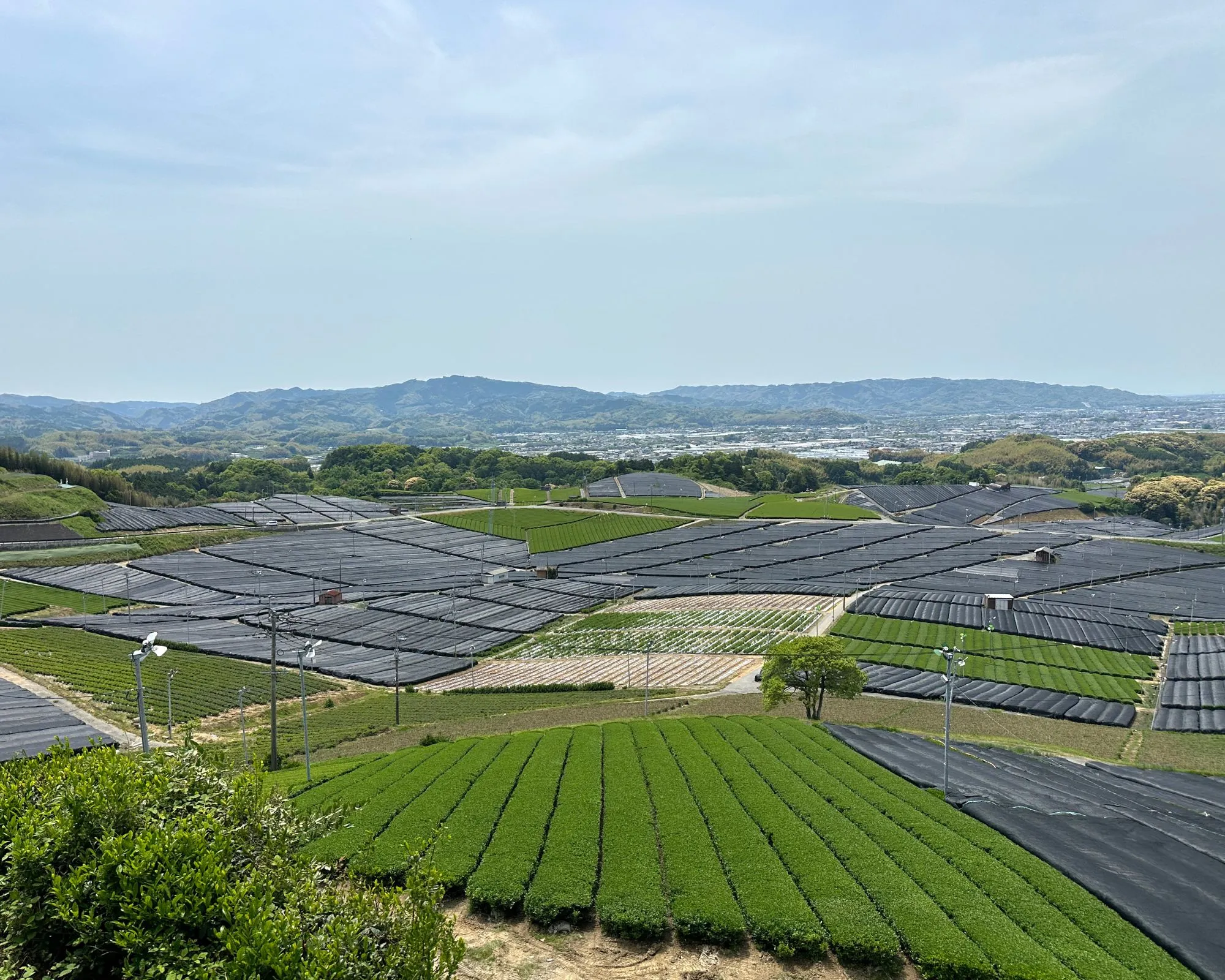
Japanese Matcha Terroirs
Like wine, matcha carries the character of its origin. Soil composition, microclimate, altitude, and regional farming traditions all shape what ends up in the bowl, and the differences between regions are not subtle.
Uji, in Kyoto Prefecture, is the historical heartland of Japanese matcha. Its cool temperatures and long shading traditions produce teas with pronounced floral notes, deep umami, and a creamy finish. Uji matcha is the benchmark against which others are often measured.
Yame, in Fukuoka Prefecture, is known primarily for gyokuro and sencha, but its matcha has a character of its own: buttery, nutty, and notably smooth, shaped by warmer temperatures and the fertile soils of the Hoshino River valley.
Shizuoka, Japan's largest tea-producing prefecture, focuses mainly on loose-leaf green tea but produces matcha with clean umami and sweet vegetal notes. Its volcanic soils, at the base of Mount Fuji, add a mineral quality that is immediately recognisable.
Kagoshima, at the southern tip of Kyushu, produces matcha with a bolder, more robust character: vegetal, umami-forward, and with enough structure to hold its own in milk-based drinks and cocktails. The volcanic soil here is among the most mineral-rich in Japan.
Nishio, in Aichi Prefecture, is one of Japan's most established matcha regions, producing teas with a reliable balance of sweetness and umami that has made it a consistent choice for ceremonial preparation.
What Does Matcha Taste Like?
The first impression is umami: a deep, savoury quality that has no real equivalent in other beverages. It arrives almost immediately and settles into something broader as the tea develops in the mouth, where sweetness becomes more apparent, accompanied by a green, vegetal depth. The finish is clean. In a well-made ceremonial matcha, there is no harshness, no bitterness that lingers.
The flavour varies significantly by origin and grade. Yame matcha tends toward nutty and velvety, with notes of white chocolate and Brazil nut. Uji matcha is more floral and silky. Kagoshima is bold and umami-forward. Shizuoka sits toward the mineral, verdant end of the spectrum. Lower-quality matcha can taste flat, astringent, or simply green without depth. Grade and preparation both matter considerably.
Matcha Production
All tea comes from Camellia sinensis, which has two primary varieties: var. sinensis and var. assamica. Within those varieties, cultivated varieties (cultivars) have been developed with specific characteristics, in the same way grape varieties are bred for wine or bean varieties for coffee. Japan has approximately 150 registered and unregistered cultivars, and the choice of cultivar shapes the character of the finished matcha as fundamentally as anything else in the process. Cultivar defines personality. Where it is grown shapes how that personality is expressed.
Yabukita accounts for 70–80% of Japan's tea production overall, but it is not always the ideal cultivar for matcha. Many of the most prized shaded-tea cultivars originate from Uji, where gyokuro and matcha production has the longest tradition. Cultivars such as Gokou, Samidori, Asahi, and Ujimidori are frequently encountered in high-grade ceremonial matcha.
AVANTCHA's Ceremonial Grade Kagoshima blends four cultivars: Yabukita, Okumidori, Okuyutaka, and Zairai, each contributing something distinct to the final cup. Most matcha is blended for consistency and balance; single-cultivar matcha reveals the unmediated character of one variety. Both approaches are valuable and worth exploring. For a deeper look at how individual cultivars express themselves in the cup, see our guide to understanding matcha cultivars.
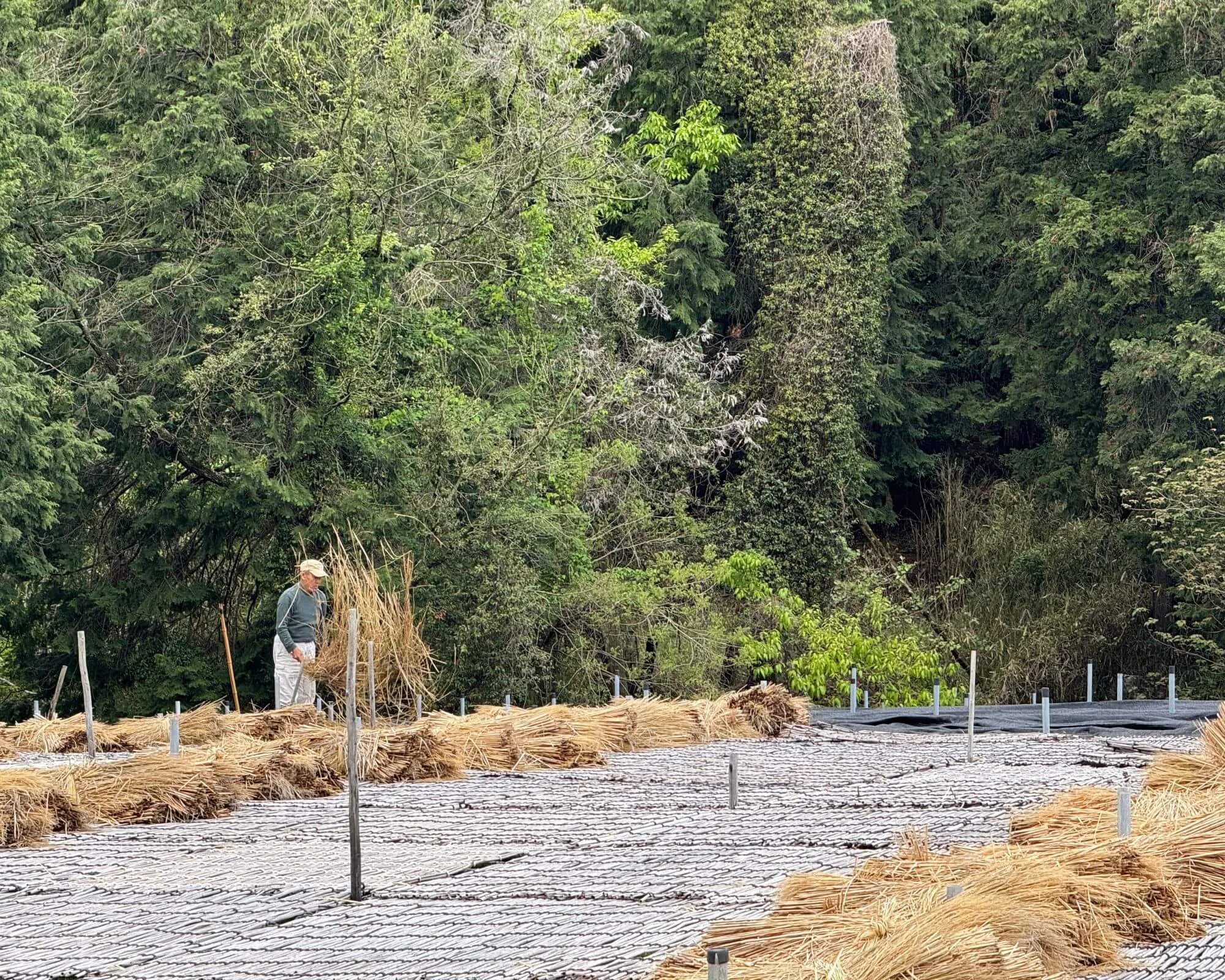
Matcha Shading
Through winter, the tea bush is dormant, drawing nutrients down into its roots. As temperatures rise in spring, those stored nutrients move back up into the newly sprouting buds. It is at this point, between three and five weeks before harvest, that matcha farmers begin shading their plants, reducing sunlight exposure by up to 85%.
The effect is significant. Deprived of direct light, the plant produces more L-theanine, the amino acid responsible for matcha's umami depth and characteristic sweetness. Chlorophyll production increases, deepening the leaf's green colour. The catechins responsible for bitterness diminish. The shading process also produces a distinct aroma known as hifuku kaori (被覆香り), the covering aroma, caused by the presence of dimethyl sulfide and reminiscent of fresh green seaweed.
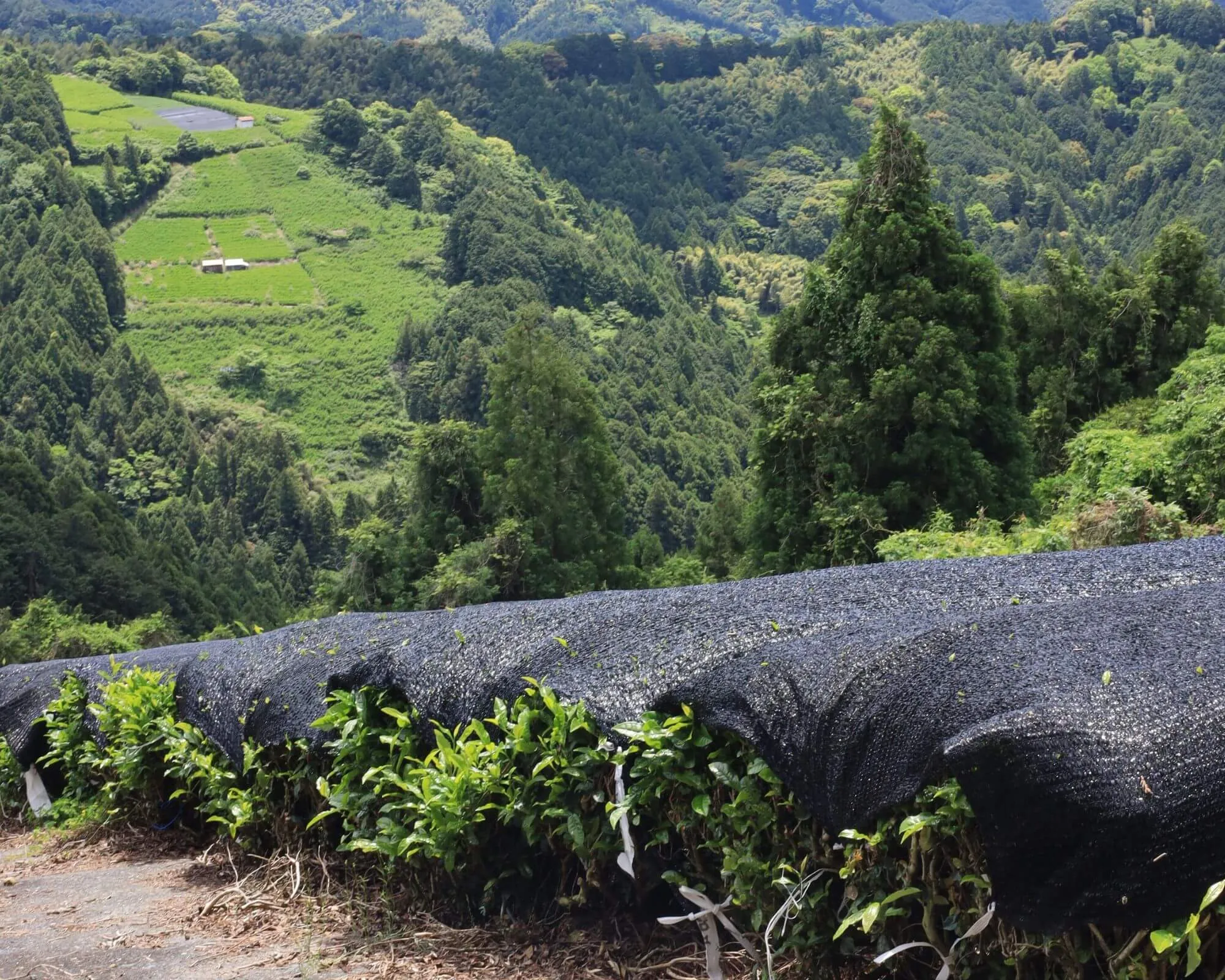
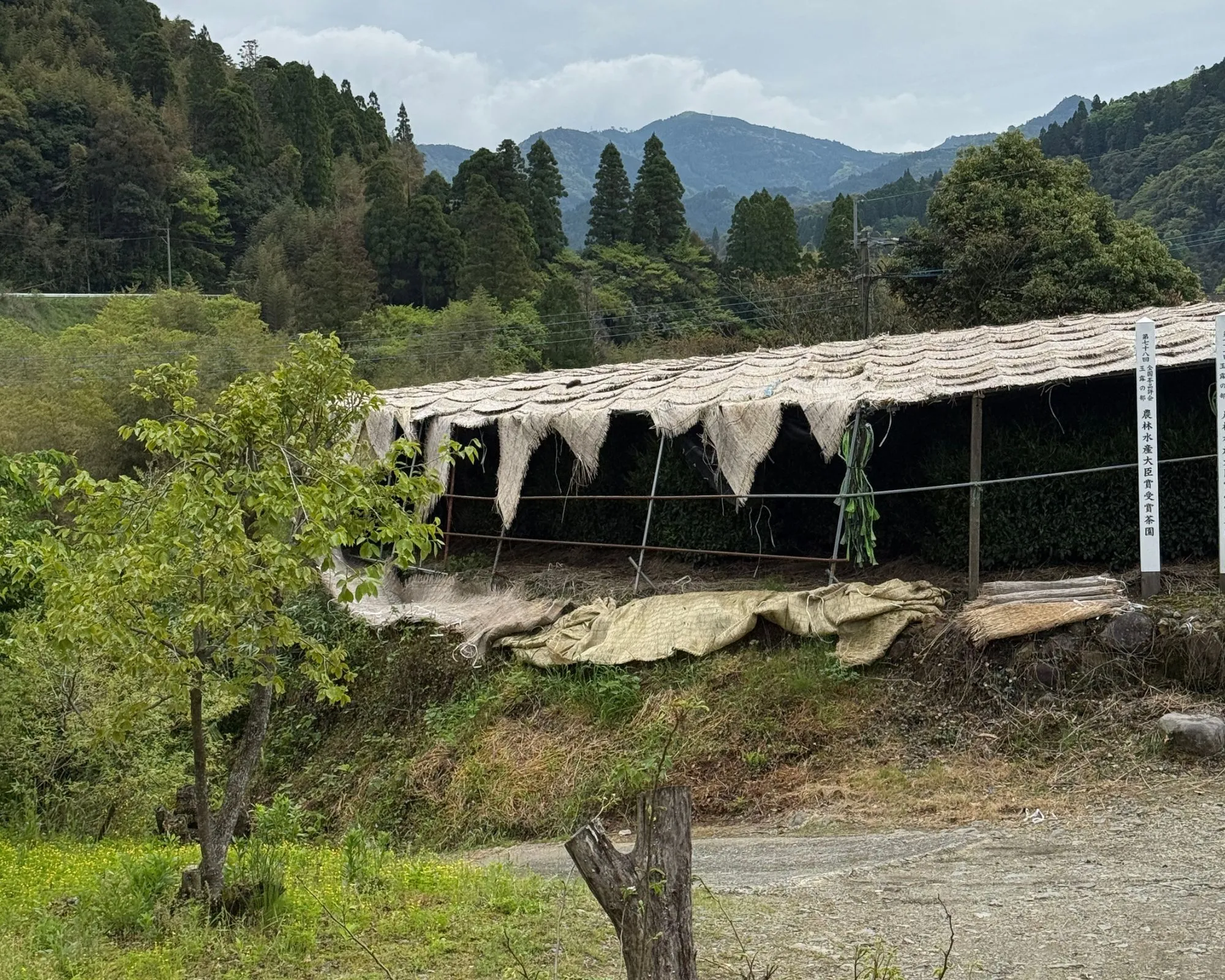
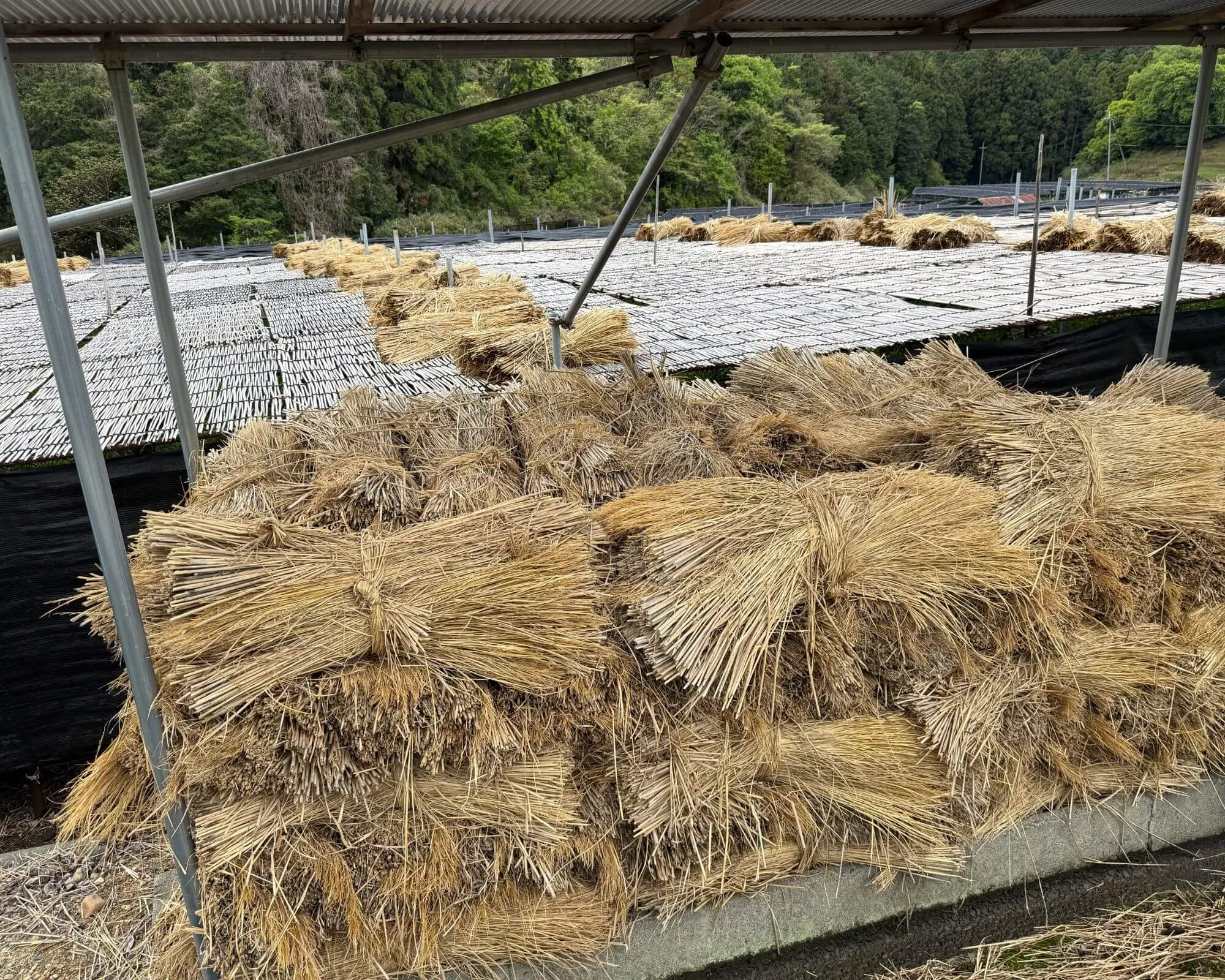
Two main shading methods are used. The traditional honzu technique (本簾被覆) uses straw to provide partial, adjustable shade and is labour-intensive. Modern methods use black synthetic fibre (kanreisha, 寒冷紗), which offers precise and uniform control over shade intensity. Each approach produces subtly different results in the leaf.
Matcha Harvest
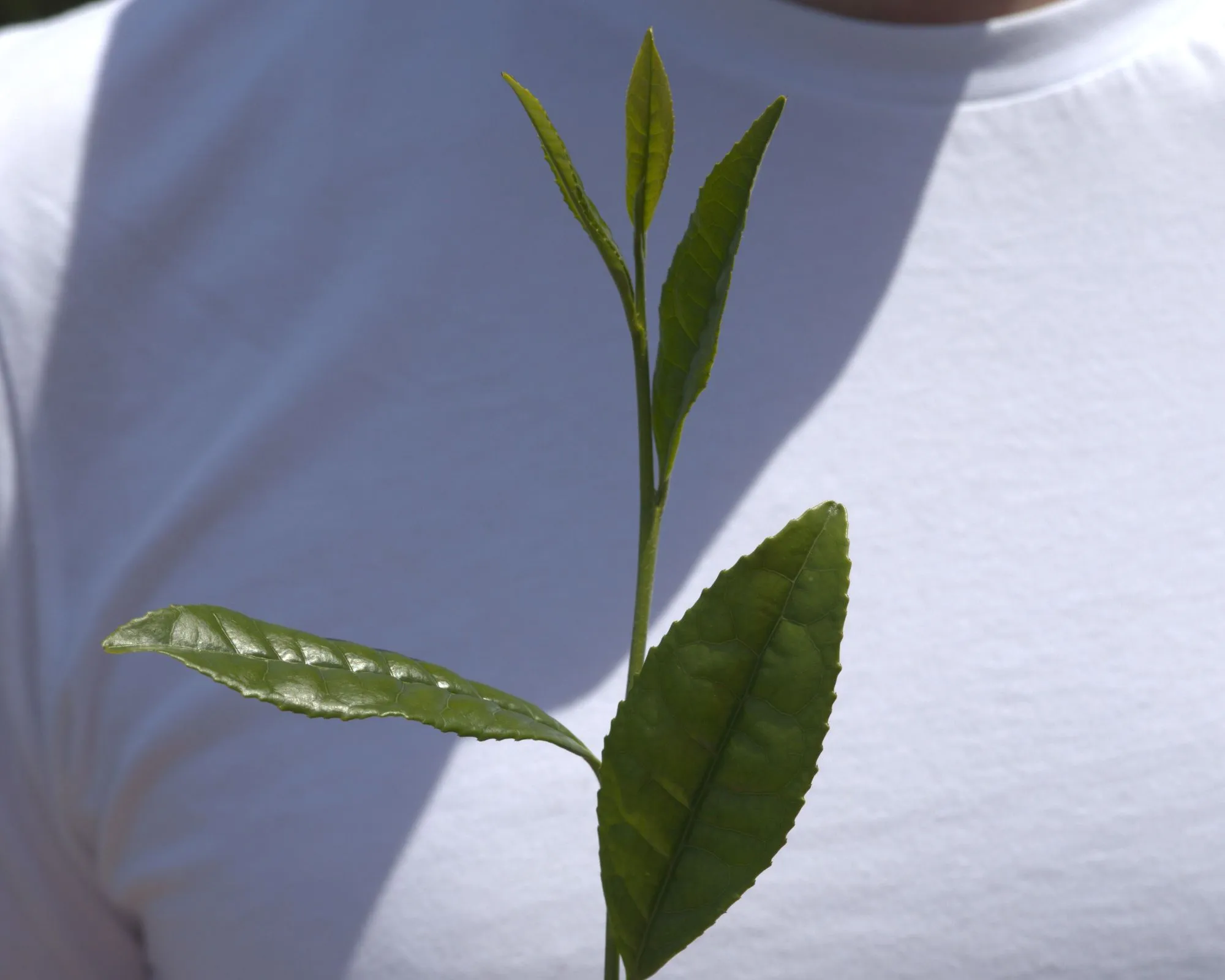
The first spring harvest, known as ichiban cha, produces the finest matcha. At peak quality, only the top two leaves and a bud are selected. Traditional hand-harvesting remains the standard for the highest grades, though mechanised harvesting is increasingly used as labour costs rise. Leaves harvested in summer or autumn are generally used for lower-grade matcha, suited to lattes and culinary applications.
Processing Tencha
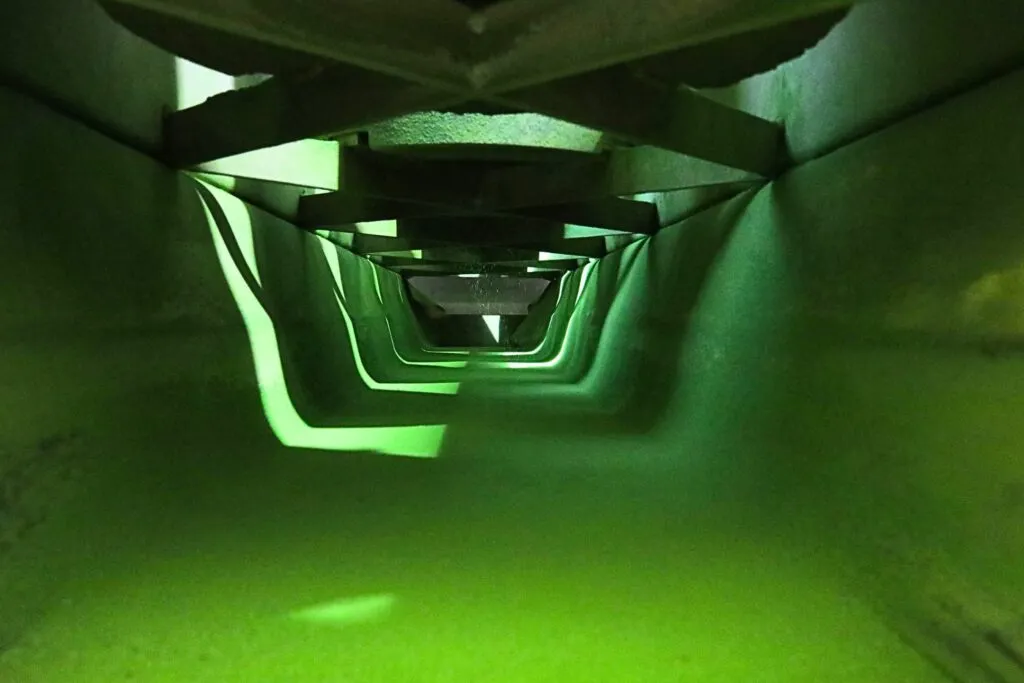
Unlike most Japanese green teas, matcha leaves are not rolled after harvest. Instead, they are immediately steamed for approximately 20 seconds, a step that halts oxidation, preserves the leaf's green colour, and eliminates unwanted aromas. The steamed leaf is then moved through a series of wind turbines to cool and separate the leaves, before passing through a roughly 10-metre brick oven with three or four conveyor belt layers for even, gradual drying. This oven was invented in 1924 by Horii Chōjirō (堀井長次郎) and transformed the consistency of the drying process.
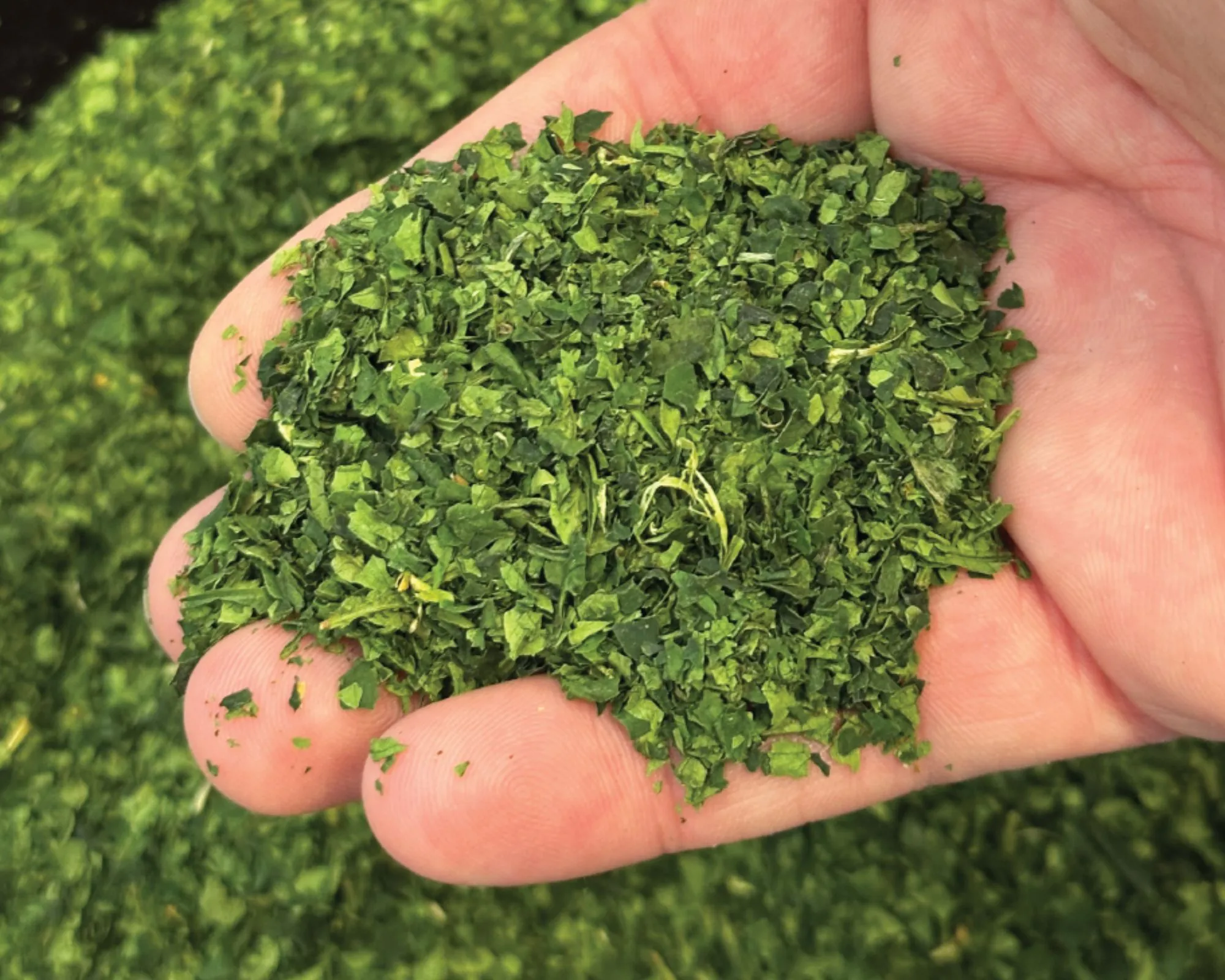
The dried leaves at this stage are known as ara-tencha (荒碾茶), raw tencha. They undergo further refinement: stems and veins are removed, the leaf is cut into uniform flakes, filtered, and dried again. In the traditional Japanese tea market, purchasing relationships between farmers and vendors were historically governed by iritsuke (入着け), a system built on long-term trust. Since 1974, the hinpyōkai (品評会) tea auction in Kyoto has offered a more contemporary route to market, where buyers assess specific flavour, aroma, and colour profiles against their blending objectives.
Tencha is stored in leaf form rather than powder form, which allows it to age and maintain freshness for longer. It is only milled when needed, ensuring the powder reaches the customer at its most vibrant.
Matcha Grinding
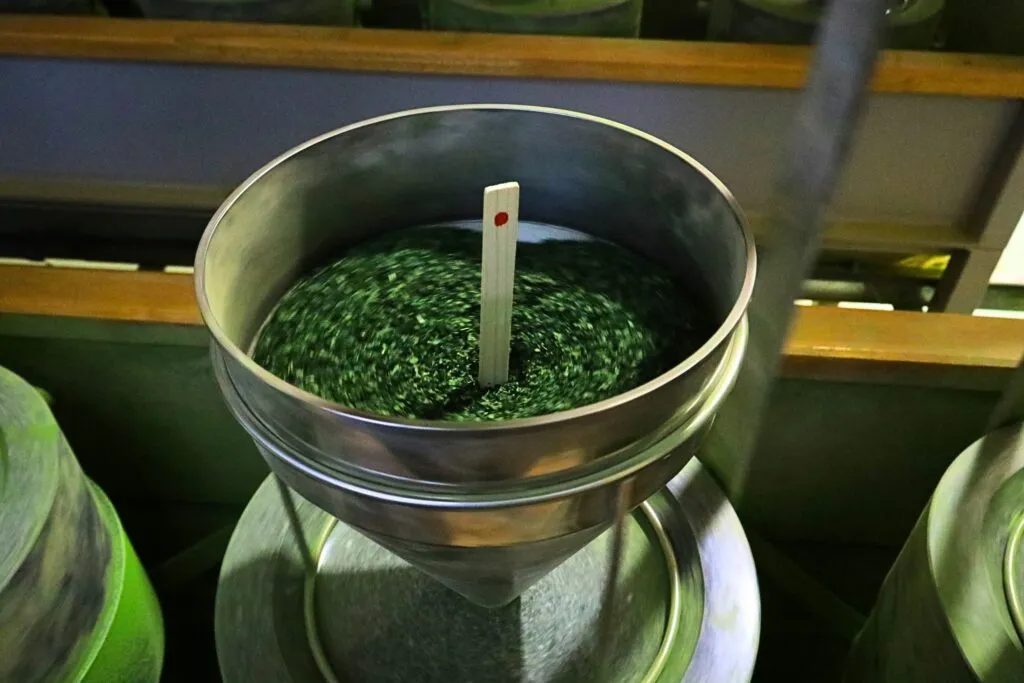
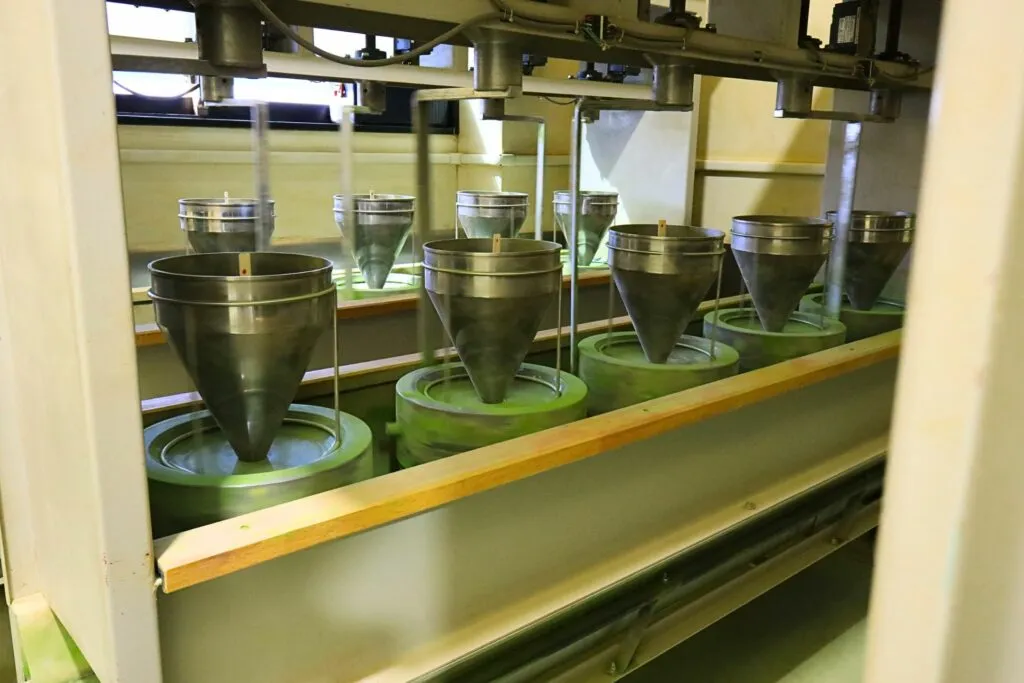
Tencha is ground into matcha using granite stone mills, which operate slowly, at around 30–40g per hour, producing as little as 400g of finished powder per mill per day. The slowness is deliberate: the friction of faster grinding generates heat, which degrades the powder's colour and aroma. Grinding takes place in temperature and humidity-controlled environments for the same reason. Some producers use jet milling for higher volumes and lower cost, but stone milling remains the standard for quality ceremonial matcha.
Why Matcha is Different From Regular Green Tea
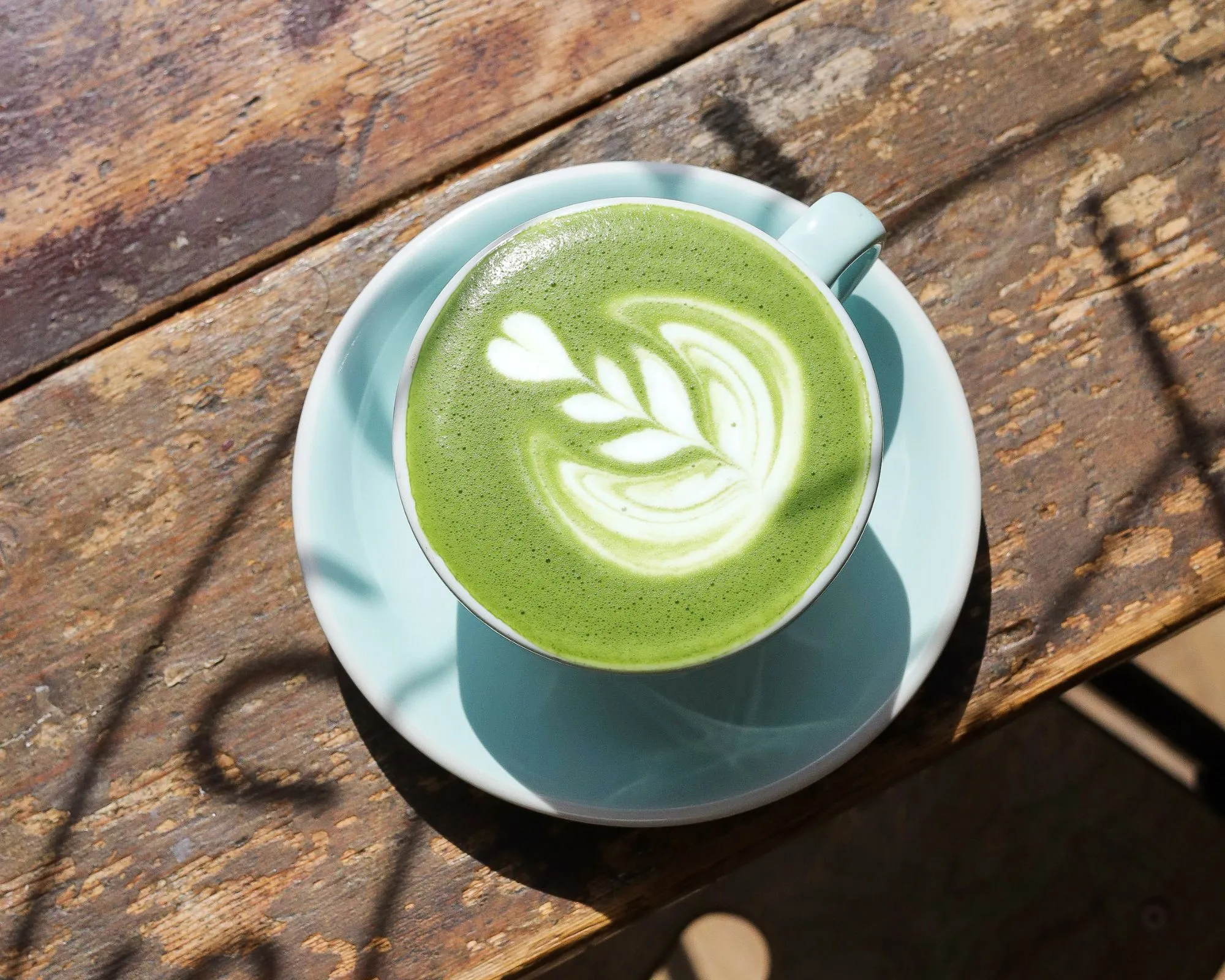
Matcha Preparation Tools
Matcha preparation tools, known as sadōgu (茶道具) or dōgu for short, are essential for preparing Matcha in the traditional Japanese tea ceremony. These utensils are not merely functional but are often regarded as exquisite works of art. During a tea gathering, the host carefully selects pieces that harmonise with each other, a practice known as toriawase (取り合 わせ), to create a cohesive theme or reflect the current season. When making Matcha at home, essential tools such as a bamboo whisk (chasen), a bamboo scoop (chashaku), a tea bowl (chawan), whisk holder (kusenaoshi), and a tea strainer (furui) are recommended for an authentic yet simple experience.
.jpg?w=2000&h=1600)
Chawan Bowl – 茶碗
The chawan is a simple ceramic bowl designed for both making and savouring Matcha. Originating in China and introduced to Japan in the 13th century, leading to a thriving artistic industry for their production. Typically short and wide in shape, chawan allows for easy whisking in an ‘M/W’ shape, creating a light foam on the surface of the Matcha. Historically, Chinese tea bowls like the Jian chawan, known as Tenmoku chawan in Japan, were favoured until the 16th century, with the term “tenmoku” derived from Tianmu Mountain in China. As tea culture spread in Japan, local adaptations emerged, such as the Seto-made copies of tenmoku during late Kamakura period (1185–1333), and the Korean-influenced Ido chawan during the late Muromachi period (1336–1573), prized for their simplicity during the wabi tea ceremony. Annan ware from Vietnam was also popular during the Edo period (1603 – 1868), reflecting diverse cultural influences and evolving ceramic craftsmanship. Today, esteemed chawan include raku ware, Hagi ware, and Karatsu ware.
Shop AVANTCHA Chawan Matcha Bowl
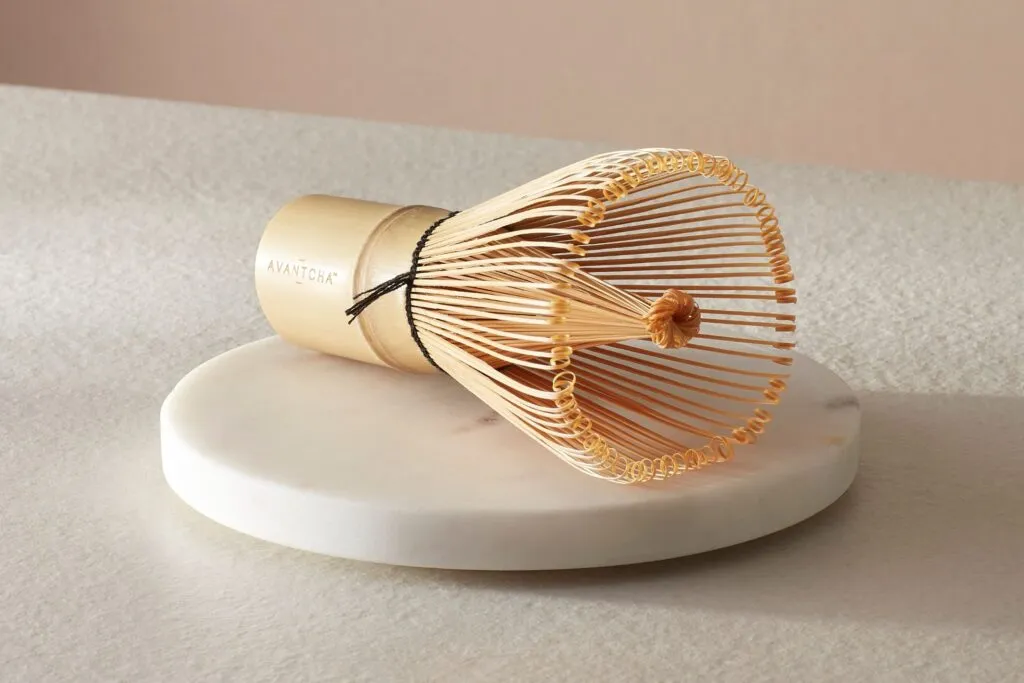
Chasen Whisk – 茶筅
The chasen, a traditional whisk for Matcha, has a storied history dating back over 600 years in Japan. Crafted from a single piece of bamboo with around 80-120 tines, seasoned for up to two years, the chasen is designed to coax Matcha into a light, even foam. Legend traces its origins to the 14th century, during the Muromachi period, when tea master Murata Jukō requested a high-quality whisk from Sosui Irido, a friend associated with Takayama Castle. This marked the inception of chasen craftsmanship, leading to the development of the delicate artistry seen in modern-day Matcha whisks. Today, despite the decline in traditional craftsmanship, a handful of master artisans in Takayama, Nara Prefecture, continue to handcraft chasen using locally sourced bamboo. The careful selection and sun-drying of bamboo contribute to its durability and quality, with each whisk exhibiting unique characteristics reflective of its maker’s expertise. While mass-produced alternatives exist, the timeless elegance and superior craftsmanship of Japanese-made chasen remain unmatched, embodying the essence of the Japanese tea ceremony.
Shop AVANTCHA Chasen Matcha Whisk
.jpg?w=2000&h=1600)
Electric Matcha Whisk
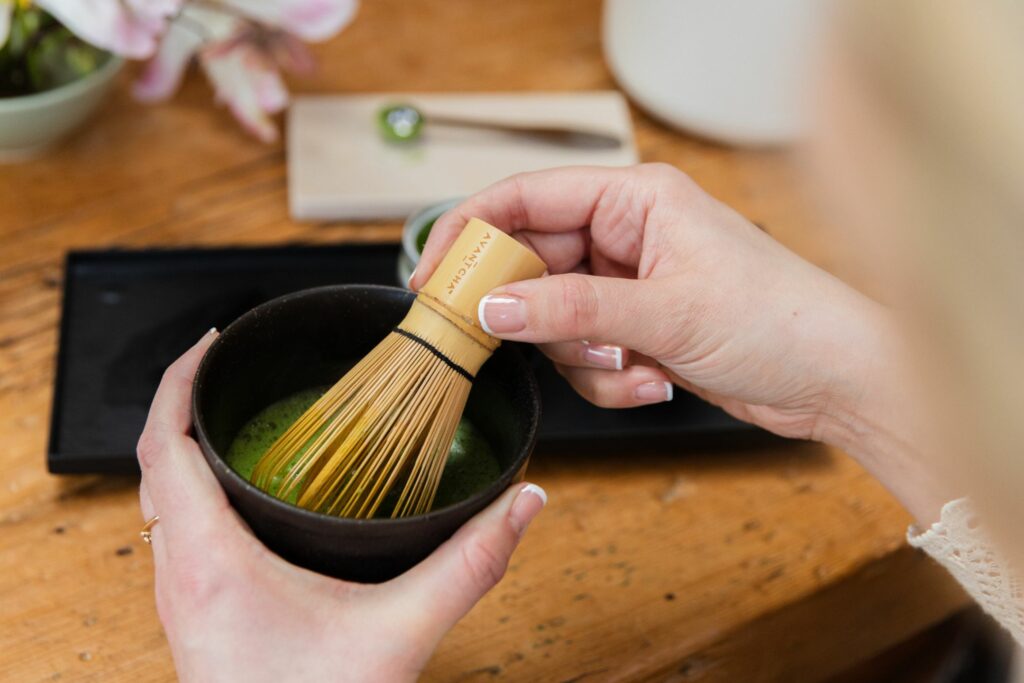
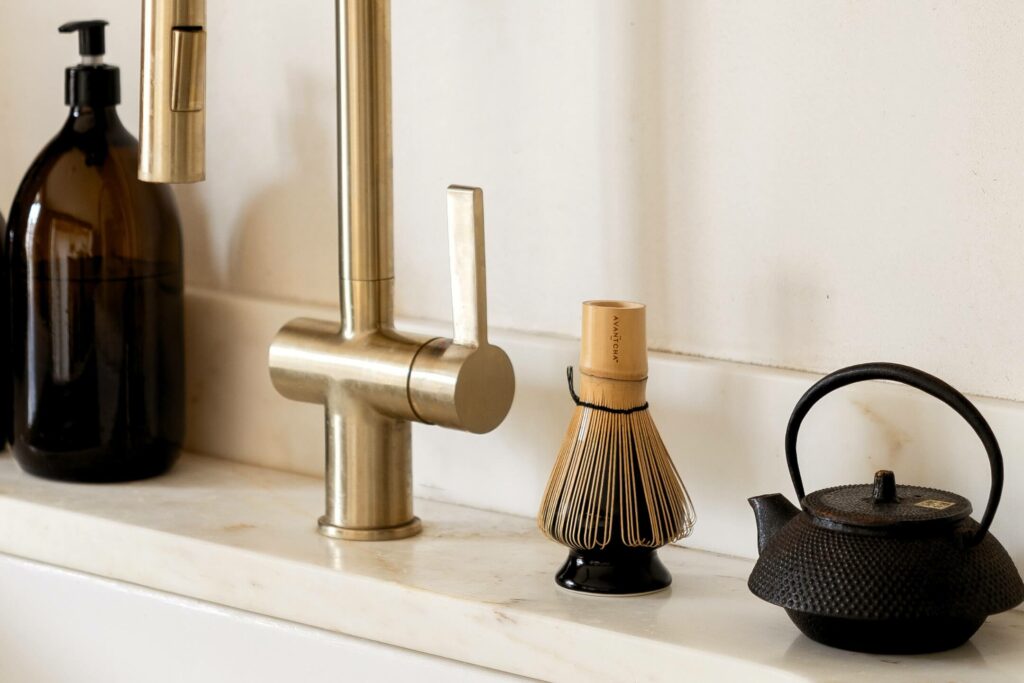
Chasen Kusenaoshi – くせ直し
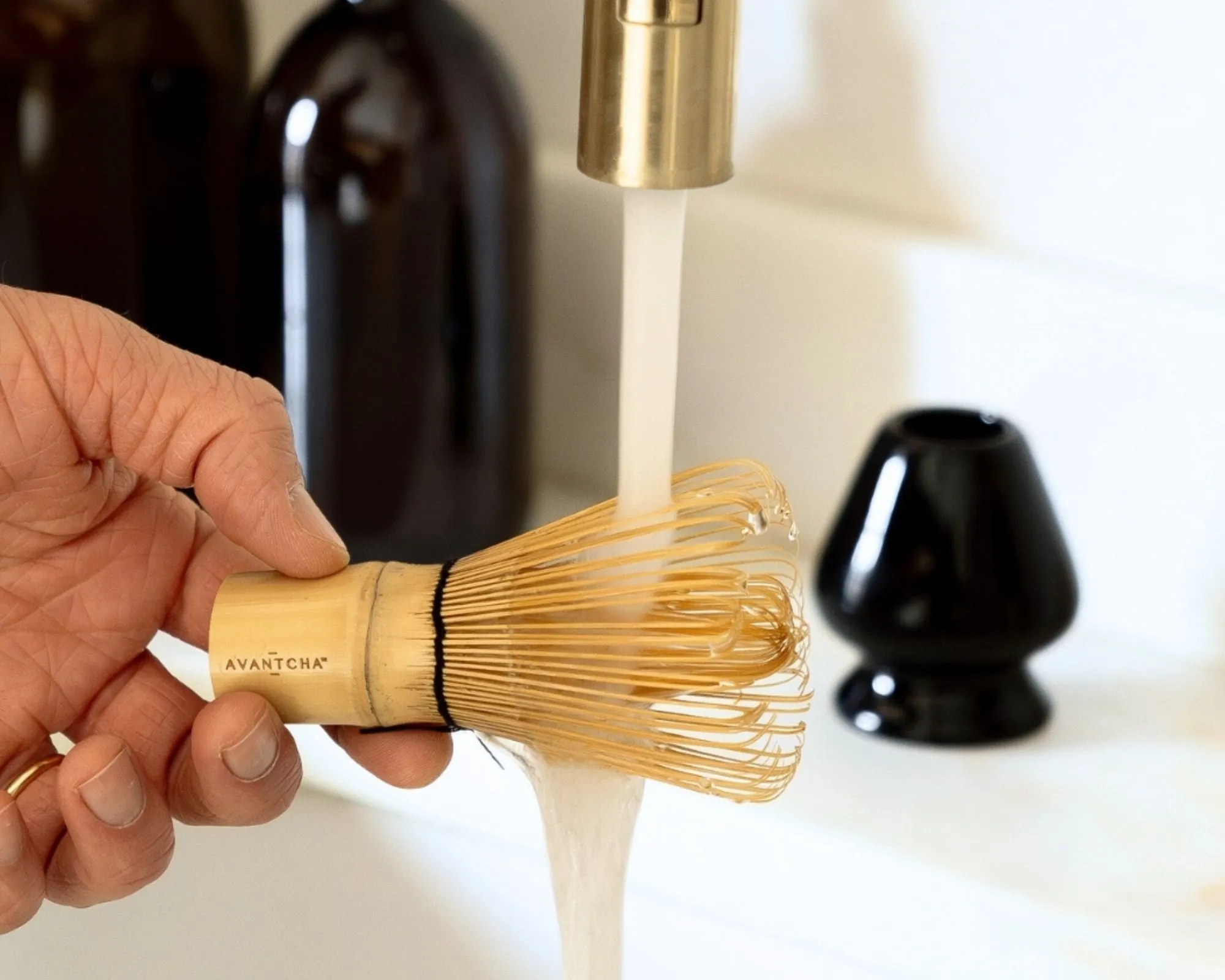
To consistently make good Matcha, it’s important to take care of your chasen whisk by using a ‘kusenaoshi’ whisk holder to retain the curved shape and also safeguards its delicate bamboo tines from damage. Additionally, it serves as a convenient storage and display accessory for your chasen when not in use.
Shop AVANTCHA Chasen Kusenaoshi Matcha Whisk Holder
Chashaku – 茶杓
The chashaku, a slender bamboo scoop, serves the purpose of transferring Matcha tea powder from storage containers into the Matcha bowl with precision. Typically made of bamboo, the chashaku features a narrow and compact design, holding approximately half a teaspoon of Matcha powder.
For creating a perfectly balanced Matcha latte, we offer a stainless steel Matcha measuring spoon that holds 1.5g per scoop.
.jpg?w=2048&h=1365)
Sieve – 篩
Upon opening freshly purchased Matcha, you might notice the formation of small clumps within the powder. These clumps occur naturally due to factors such as moisture and the weight of the powder settling over time. These clumps can slightly hinder the proper whisking of Matcha and can affect its smooth taste. A small sieve is specifically crafted to address this issue by conveniently sifting Matcha powder and breaking up clumps effectively. Designed in a compact size for convenience, it can be used to sift Matcha beforehand for tea ceremonies or at home.
Top Tip: When we were visiting our tea farmers in Shizuoka, however, their recommendation was to add the Matcha to the bowl with a little cold water and to mix this to a smooth paste before topping up with 70 degree water and whisking to a foam. They explained how using cold water in this way would remove any soft clumps, and also illicit the sweet ‘amami’ that Matcha naturally has, as well an ensuring that the ‘umami’ (savoury) notes could shine through. Why not try it both ways and see which you prefer?
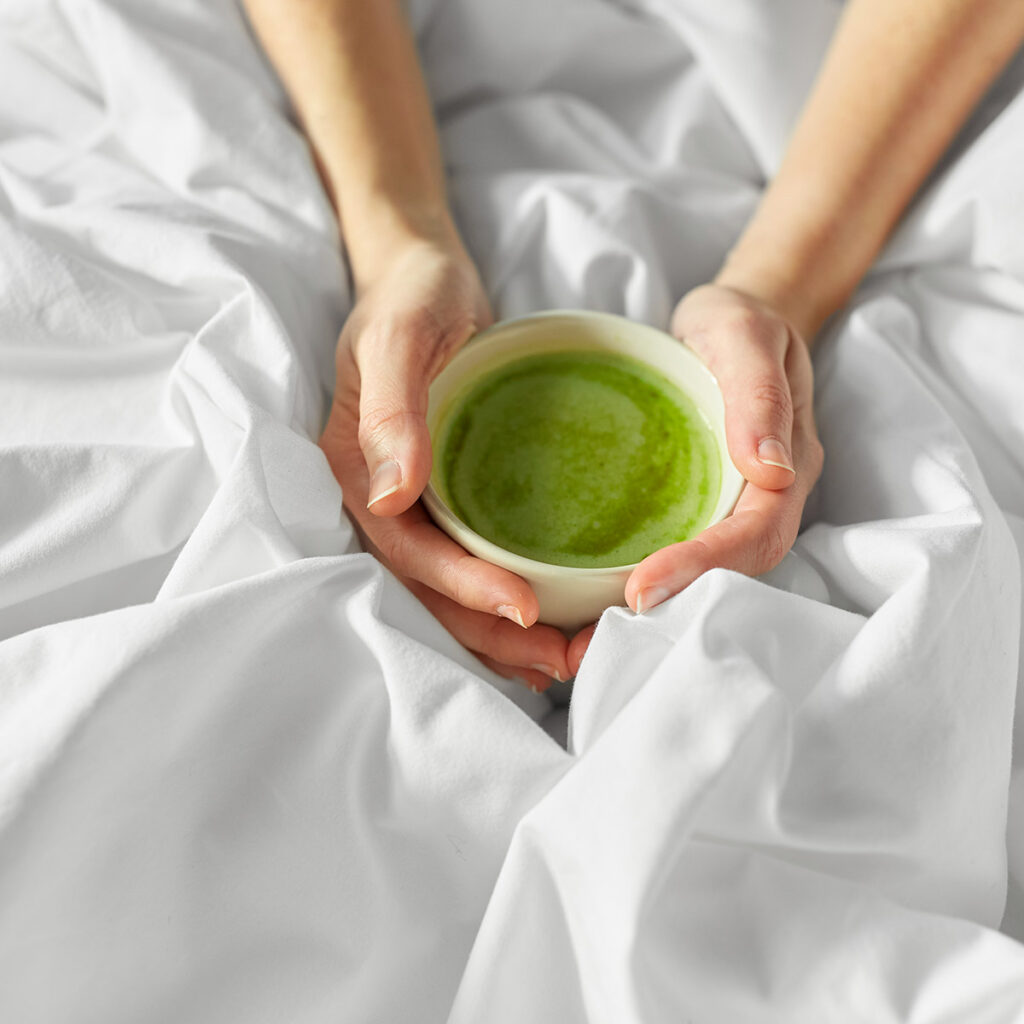
How To Make Matcha for Ceremony
There is more than one way to prepare matcha, and experimentation is worthwhile. An electric whisk works. A cocktail shaker with ice and milk produces something excellent. But for the traditional preparation, the method below is the one worth learning first.
A note from tea farmers in Shizuoka worth following: add the matcha to the bowl with a small amount of cold water first and mix to a smooth paste before adding hot water. Cold water draws out the natural sweetness (amami) of the matcha and allows the umami notes to come through more clearly. It also removes any soft clumps without sieving. Try both methods and judge for yourself.
Warm the chawan and chasen with hot water, then discard it and dry the bowl. This step also softens the bamboo tines, which extends the life of the whisk.
Sift the matcha into the bowl. Use approximately two chashaku scoops, or one level teaspoon.
Add roughly 10ml of cold water and mix gently with the chashaku until the powder forms a smooth, lump-free paste.
Add 60–70ml of hot water at 70–80°C. In Japan, boiling water is sometimes used, and the result is still excellent, depending on the Matcha. Start at 70°C and adjust to your preference.
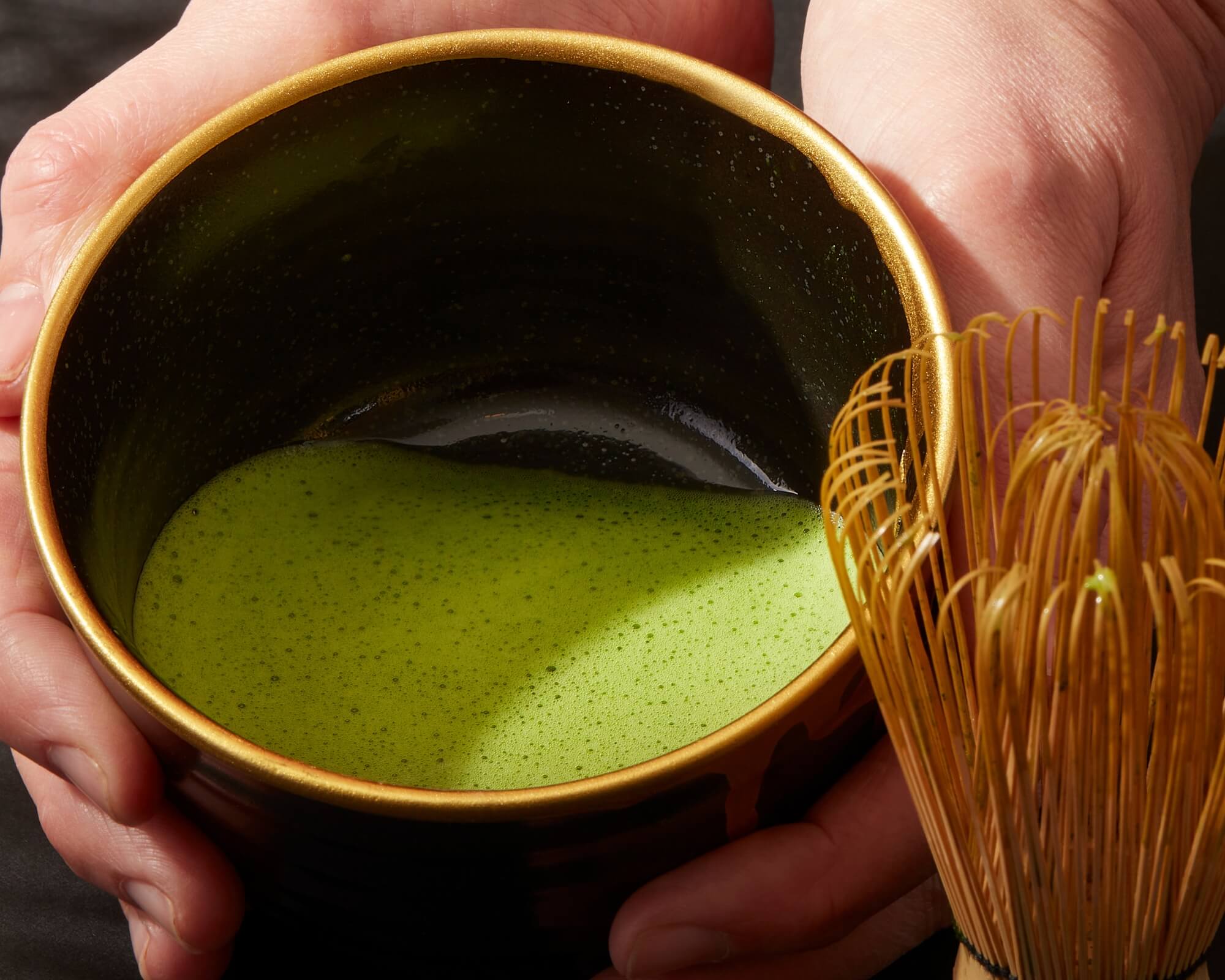
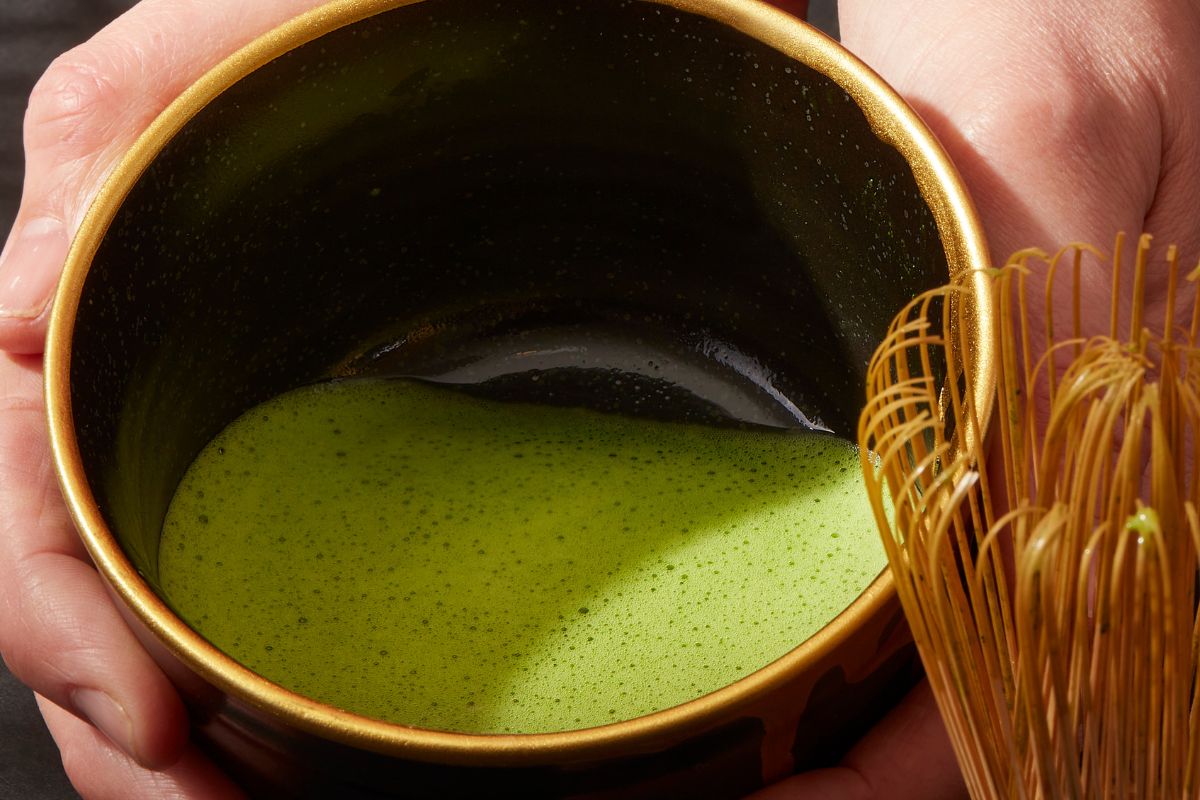
Whisk briskly in a W or M motion at the surface of the water, not in circles, until a fine foam forms. When the foam develops, bring the whisk slowly upward and burst any large bubbles at the surface.
Drink immediately.
Koicha and Usucha Matcha
Within the Japanese tea ceremony, matcha is prepared in two distinct ways that represent different moments in a gathering and require different grades of leaf.
Koicha (濃茶, thick tea) is made from the finest tencha leaves, at a ratio of approximately 4g of matcha to 30ml of water. Rather than whisking, the matcha is kneaded (matcha wo neru, 抹茶をねる) to produce a smooth, syrup-like consistency without foam. The result is intensely umami, noticeably sweet, and deeply complex. Koicha is shared among participants in the ceremony, a gesture of communal experience. It is traditionally served in raku-yaki bowls and accompanied by wagashi sweets.
Usucha (薄茶, thin tea) uses less matcha and more water, and is prepared by whisking to produce a light foam. It is the more familiar preparation outside the tearoom, and each guest receives their own bowl. Usucha is more approachable in flavour than koicha, with the umami still present but softened.
For those wishing to try koicha at home, our Ceremonial Grade Yame Yabukita, with its sweet, velvety, white-chocolate character, is the right starting point.
Organic Matcha Vs. Non Organic Matcha
Organic matcha reflects older farming methods, before the introduction of modern pesticides and synthetic fertilisers. The flavour tends toward verdant and earthy, with a more robust vegetal character. Non-organic matcha may use specific fertilisers to develop a more abundant umami, a balanced sweetness, and a richer green colour.
Neither is categorically better. The choice depends on what you are looking for in the cup and what matters to you in farming practice. It is worth knowing that many small Japanese tea farms operate by organic principles without holding formal certification, because the cost and duration of accreditation are prohibitive. Certified organic matcha is also more limited in supply, as the agricultural methods that support it have only recently scaled to meet Western demand.
Both organic and non-organic matcha produced in Japan are subject to strict agricultural regulations. Whichever you choose, provenance and grade remain the more decisive factors for quality.
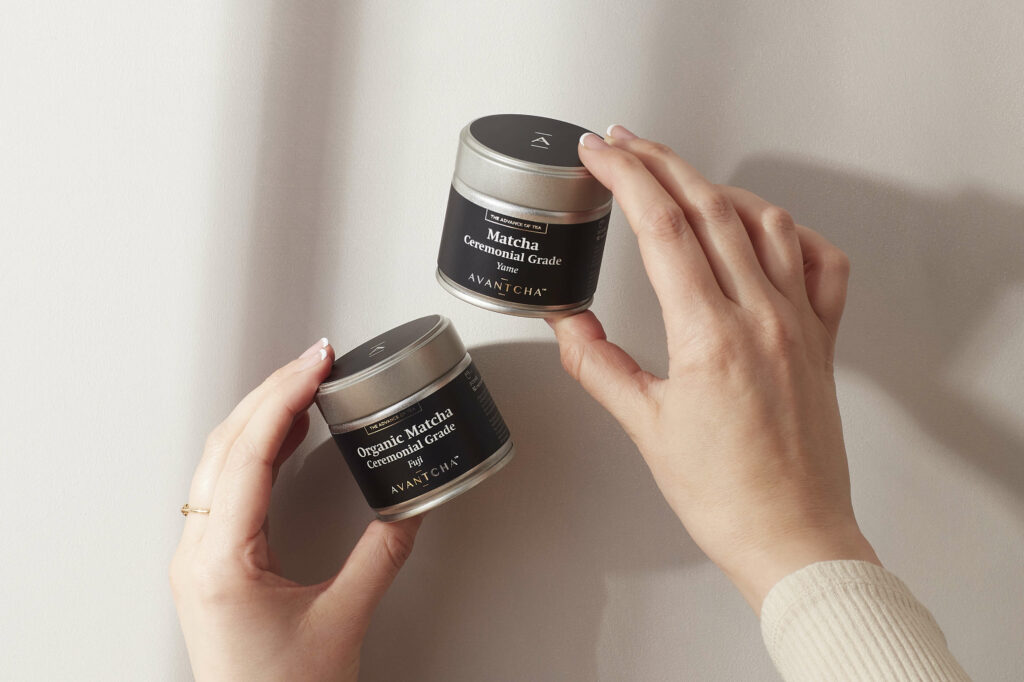
AVANTCHA Matcha is either Organic Certified (JAS), or audited by our own rigorous standards of Natural Farming, as clearly marked on the label.
Shop AVANTCHA Organic Ceremonial Grade Matcha Fuji
Shop AVANTCHA Ceremonial Grade Matcha Yame
Shop AVANTCHA Ceremonial Grade Uji Samidori Hand Plucked
Matcha Grading
There is no standardised grading system for matcha, even within Japan. Quality is assessed across multiple dimensions: foam quality, colour, aroma, texture, and flavour. Japanese tea competitions provide one reference point, though the teas awarded are rarely available outside Japan.
Within the tea ceremony tradition, two terms offer the most useful guidance. Koicha grade matcha, often marked with the character mukashi (昔), indicates sweeter, higher-quality leaf suited to thick tea preparation. Usucha grade, marked with shiro (白), is appropriate for everyday thin tea preparation and general consumption.
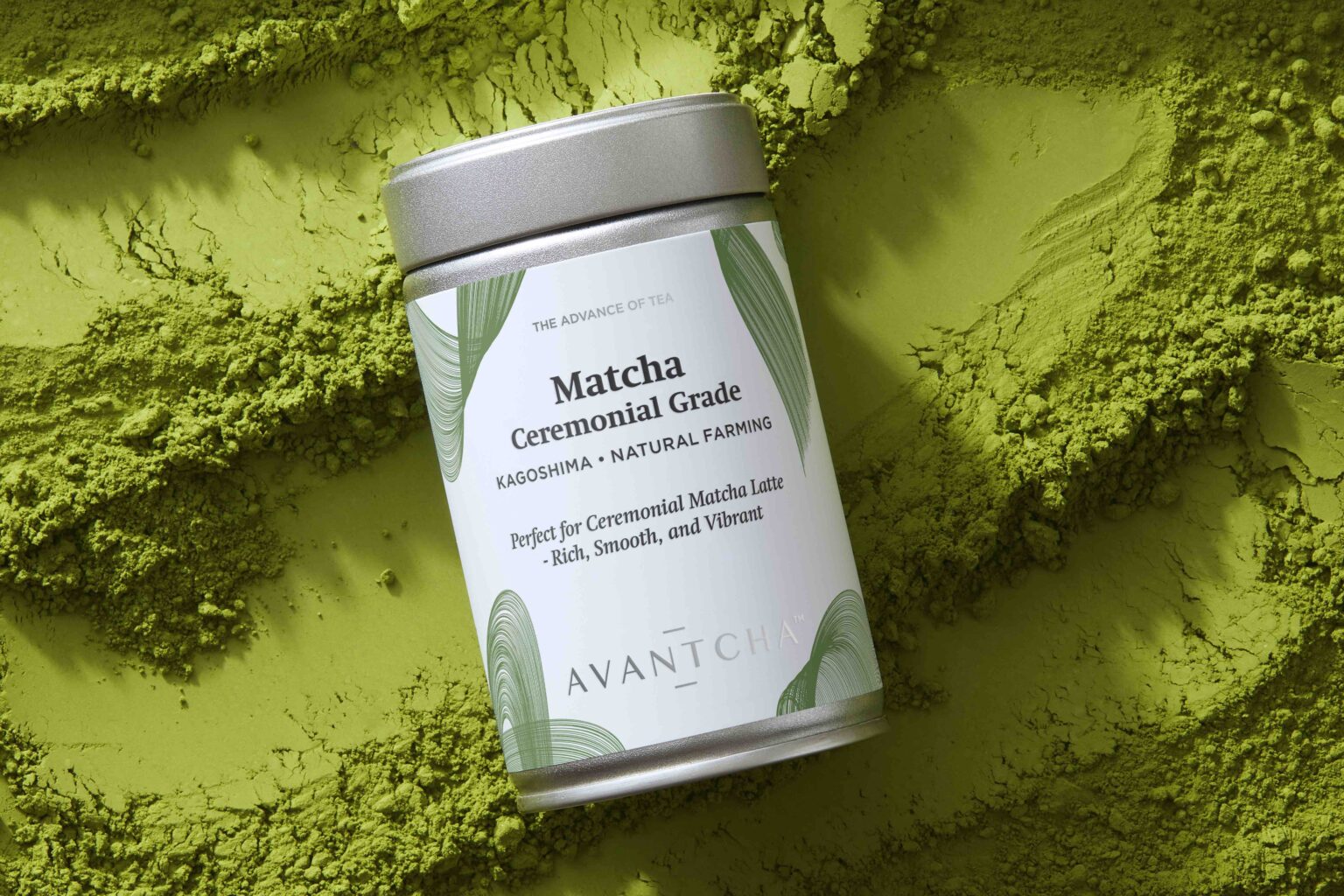
In the market more broadly, grades range from culinary to cocktail or latte grade to ceremonial. Culinary matcha has a larger particle size, a more robust flavour, and is suited to cooking where it competes with other ingredients. Cocktail or latte grade sits above this, with enough quality and clarity to hold character in beverages. Ceremonial grade is the finest available for drinking: vibrant green, fine in texture, and smooth in flavour, intended to be prepared with water and drunk on its own terms, or designed as a premium ingredient for lattes like our Matcha Ceremonial Grade Kagoshima Natural Farming.
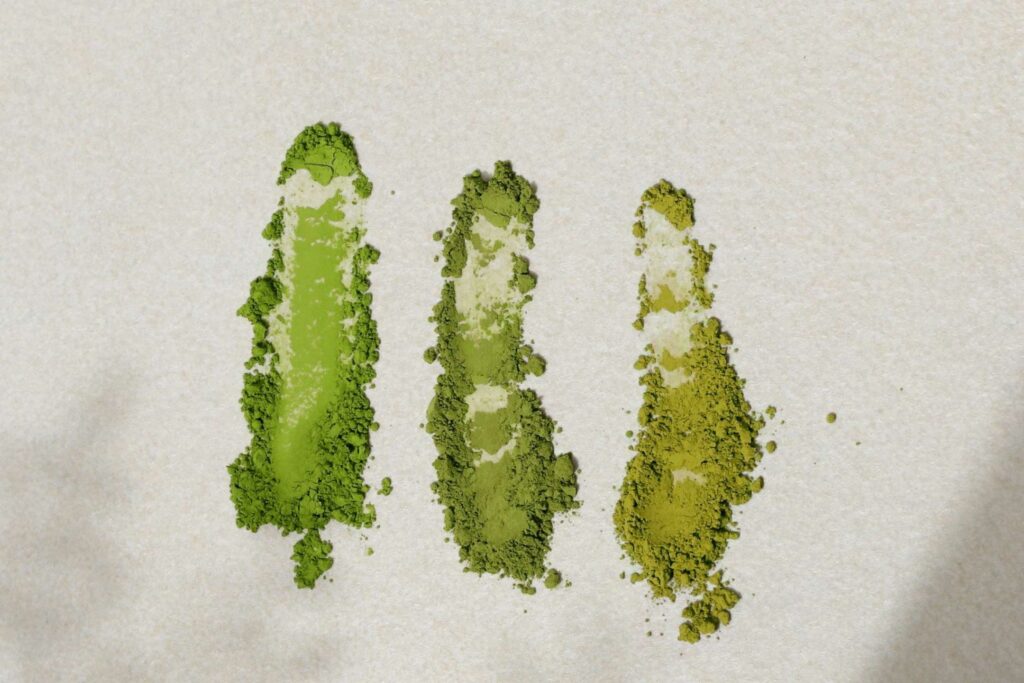
A simple way to evaluate an unfamiliar matcha is the white paper smear: spread a small amount on white paper and assess the colour. Vibrant, saturated green indicates quality. Yellowish or dull green suggests oxidation or lower-grade leaf.
How To Choose Matcha
The right matcha depends on what you intend to do with it. For lattes, cocktails, and recipes, choose a cocktail or latte grade with the robustness to hold its character through milk and other ingredients. For traditional preparation with water, choose ceremonial grade, where origin, cultivar, and processing make the most difference. For baking and cooking, culinary grade. Understanding cultivar offers a more precise way to navigate than grade alone: see our guide to understanding matcha cultivars for a full breakdown of what each variety brings to the cup.
If you are new to matcha, start with lattes and matcha-based sweets before moving toward a ceremonial grade prepared with water. Most people who take this route find the transition straightforward.
AVANTCHA's current range, in the order we would suggest trying them:
Ceremonial Grade Kagoshima Natural Farming — Smooth, sweet, umami. A four-cultivar blend from Kagoshima's volcanic soils, built for lattes, cocktails, and creative recipes. The most practical choice for daily drinking and professional use.
Ceremonial Grade Yame Yabukita — Velvety, nutty, white chocolate. Approachable and generous, this is the natural entry point into single-origin ceremonial matcha. Beautiful pure or as a premium latte.
Organic Ceremonial Grade Fuji — Mineral, robust, verdant. Grown in the volcanic foothills of Mount Fuji, this is matcha for enthusiasts: complex, layered, and deeply satisfying. Best as traditional usucha or koicha.
Platinum Ceremonial Grade Uji Samidori, Hand Plucked — Cream, spring blossom, deep vegetal umami. Sourced from a sixth-generation farm in Uji, where forty skilled pickers work for a full month each harvest season. Increasingly rare. Savour it pure, with full attention.
Matcha Pairing
.jpg?w=2000&h=1600)
How to Store Matcha
Matcha degrades quickly when exposed to light, heat, moisture, or air. Oxidation turns the colour from vivid green to dull yellow and flattens the flavour within weeks if the powder is stored carelessly.
Store unopened matcha in the freezer. Once opened, transfer to the refrigerator. When taking the container out, let it rest at room temperature before opening it, to prevent condensation from forming inside. Keep matcha away from strong-smelling foods, as it absorbs odours readily. Once opened, use within a few months.
.jpg?w=2000&h=1600)
Matcha Sourcing
The regions most reliably associated with high-quality matcha are Uji in Kyoto, Nishio in Aichi, Yame in Fukuoka, and Kagoshima. While matcha is produced in China, Vietnam, and Thailand, the most consistently excellent matcha comes from Japan, where the tradition of cultivation, processing, and grading is deepest.
When assessing quality, consider origin, cultivation method, processing approach, and freshness at the point of purchase. Matcha milled from tencha close to the time of shipment, packed in nitrogen-sealed packaging, and stored under refrigeration from producer to vendor will be meaningfully fresher than matcha that has sat in a warehouse at ambient temperature. At AVANTCHA, this is standard practice across our range.
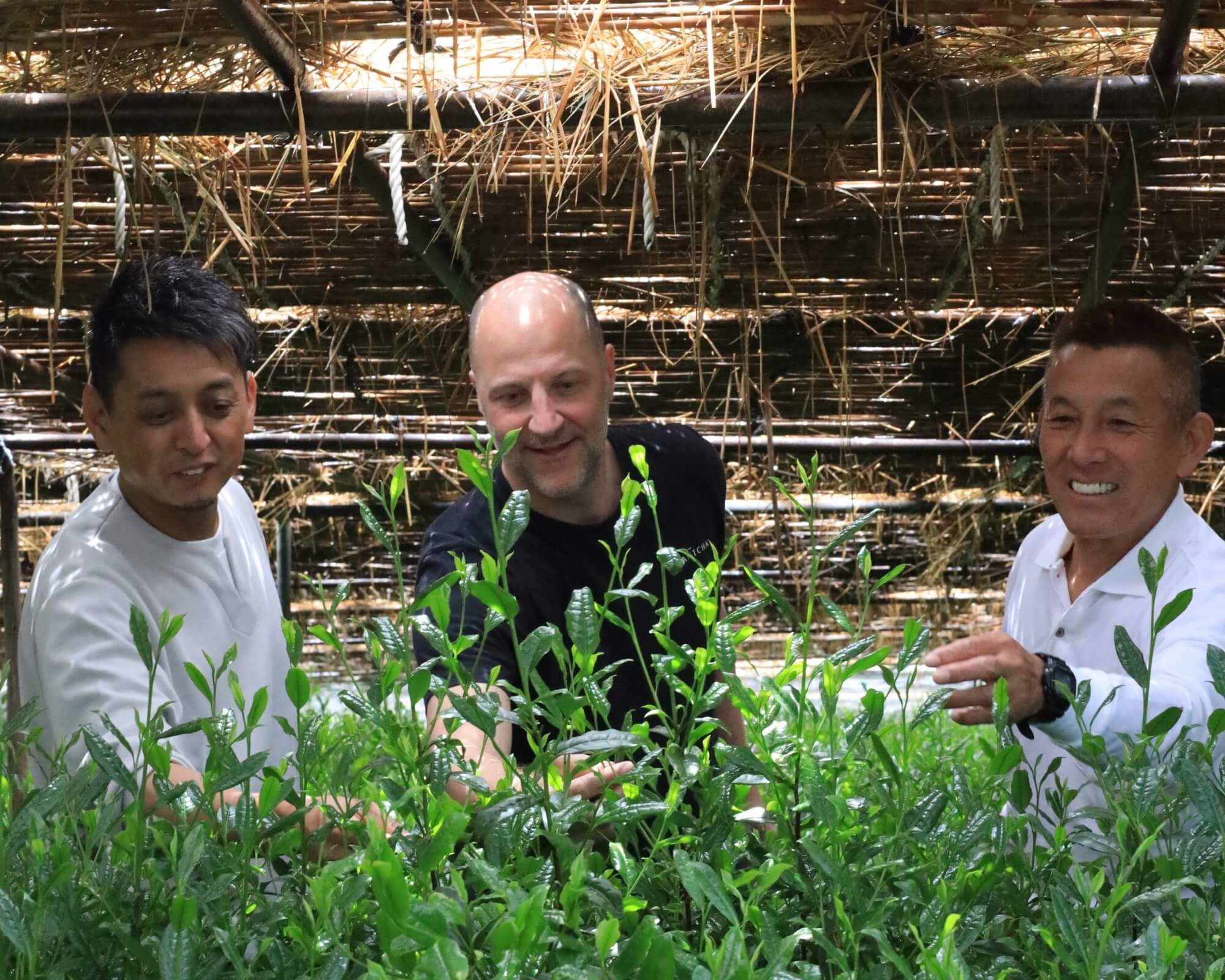
Building relationships with Japanese tea farmers takes time. The traditional tea scene in Japan operates on trust and continuity. The teas worth seeking are rarely available through casual channels.
.jpg?w=2000&h=1600)
Matcha Packaging and Quality Control
Matcha is sensitive to its environment from the moment it is milled. Light, moisture, and air all degrade the powder, which is why packaging choices matter as much as sourcing ones.
Traditional tin cans provide good protection. Modern resealable, vacuum-sealed pouches with nitrogen flushing offer the same protection with better convenience and more room to tell the story of the tea. Whichever format is used, the function is the same: to isolate the powder from everything that would diminish it before it reaches the bowl.
Labels should identify origin, grade, and expiry date clearly. Rigorous quality checks on cold storage temperature, aroma, colour, and texture are the difference between a tea that arrives as intended and one that doesn't.
All AVANTCHA Matcha and Hojicha is sealed immediately after milling in nitrogen flushed tins with a specially designed lid that keeps them air, light, and moisture tight at all times.
Matcha Recipes
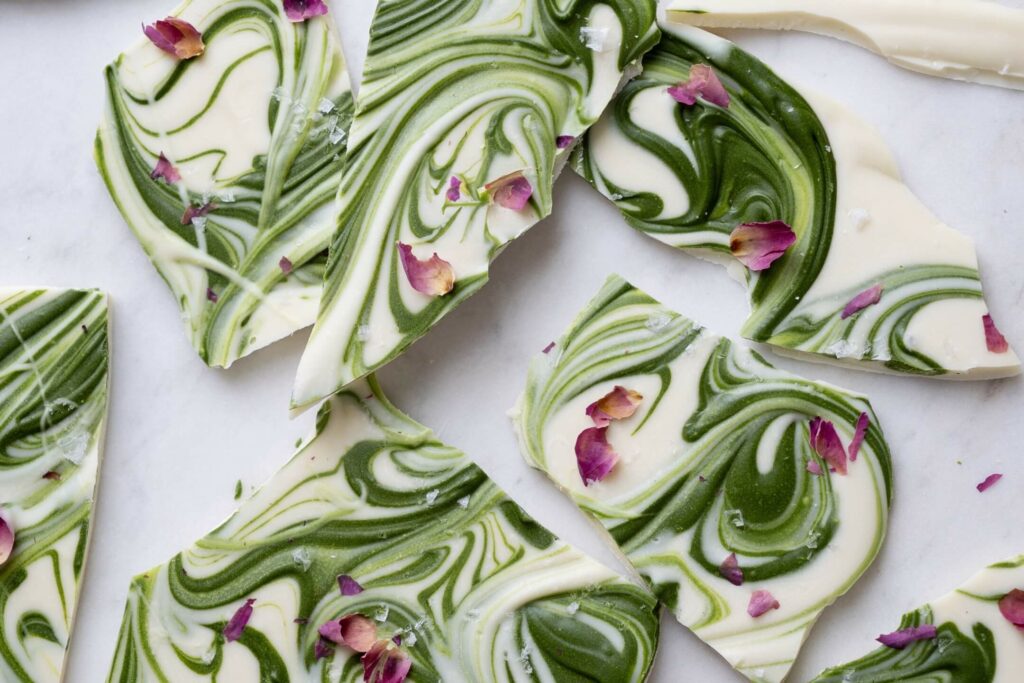
Matcha moves from bowl to kitchen with less compromise than almost any other tea. It works in cakes, cookies, and ice cream. It holds its character in noodles, salads, and dressings. It is one of the more genuinely versatile ingredients in a pastry chef's pantry, not for novelty but because the flavour is strong enough to survive heat and competition.
AVANTCHA's recipe collection is updated regularly. Sign up to our emails on the footer of this page to receive the latest.
Matcha FAQs
What exactly is matcha made from? Matcha is made from tencha: shade-grown Camellia sinensis leaves selected from the first flush of spring. After steaming to halt oxidation, the leaves are dried, de-stemmed and de-veined, and slowly stone-ground into an ultra-fine powder. Because the entire leaf is consumed rather than steeped, matcha delivers a more concentrated intake of the leaf's compounds than infused tea.
Is matcha healthier than green tea? Matcha and green tea come from the same plant, but they are not identical. Because matcha is consumed as a whole-leaf powder, it delivers a higher concentration of catechins, L-theanine, and chlorophyll than steeped green tea. Both contain L-theanine, though the shading process in matcha production raises levels significantly higher than in standard green tea. Matcha is the more concentrated form. Whether that makes it categorically healthier depends on what you are comparing and how each is prepared.
Does matcha have more caffeine than coffee? It depends on how you are preparing it. Independent laboratory analysis of our Organic Matcha Cocktail Grade Kagoshima found a caffeine content of 2.64%, equating to approximately 53mg per traditional 2g bowl. At the 4.5g serving we recommend for lattes, that rises to around 119mg, broadly comparable to a standard cup of coffee at 100–120mg. Caffeine content varies by grade, cultivar, and preparation. What consistently distinguishes matcha from coffee is not the caffeine quantity but what accompanies it: matcha contains L-theanine, which has been studied for its effect on sustained, focused attention in combination with caffeine. Most people describe the experience differently as a result.
Can I drink matcha every day? For most people, yes. One to two traditional bowls per day is a sensible range. Those sensitive to caffeine should keep matcha to the morning. The serving size matters: a traditional bowl and a latte are meaningfully different in caffeine terms, and it is worth knowing which you are choosing.
What does matcha taste like? At its best, matcha opens with deep umami, develops into sweetness and vegetal depth, and finishes cleanly with no lingering bitterness. The flavour varies by origin: Yame tends toward nutty and velvety; Uji toward floral and silky; Kagoshima toward bold and umami-forward; Shizuoka toward mineral and verdant. Lower-quality matcha can taste flat or astringent, which is why grade and preparation matter.
Is matcha good for weight loss? Compounds in green tea, including catechins and caffeine, have been studied in relation to metabolic rate and fat oxidation. Research suggests modest effects on body composition when these compounds are consumed as part of a balanced diet and lifestyle. Matcha is not a standalone solution for weight loss, and we would not describe it as one.
How much matcha should I drink daily? One to two traditional bowls per day is a reasonable starting point. Bear in mind that a latte serving contains significantly more caffeine than a traditional bowl, so if you are having both in a day it is worth factoring that in.
What is the best type of matcha to buy? For traditional preparation with water, ceremonial grade. For lattes, milk drinks, and cocktails, cocktail or latte grade. For baking and cooking, culinary grade. Within each category, origin, cultivation method, and freshness are the most decisive quality factors. Japanese matcha from established producing regions is the most consistent benchmark.
Ultimate Guide to Matcha References
Brekell, P.O. (2018). The Book of Japanese Tea. Bilingual Edition. 淡交社.
Chun, I. (2019). Everything you need to know about matcha quality. Yunomi.life.
Chun, I. (2018). Secrets about matcha. Yunomi.life.
Chun, I. (2018). How matcha is made. Yunomi.life.
Gascoyne, K. (2014). Tea: History, Terroirs, Varieties. Firefly Books, Limited.
Heiss, M.L. and Heiss, R.J. (2007). The Story of Tea: A Cultural History and Drinking Guide. Berkeley, Calif.: Ten Speed Press.
Kishida, M. (2022) All About Shading in Japanese Tea Cultivation. Yunomi.life.
Kishida, M. (2023). Looking for a matcha whisk? Here are some tips. Yunomi.life.
Kishida, M. (2022). Bamboo and the Art of Chasen Making. Yunomi.life.
Kishida, M. (2021). Befriending Japanese Tea Cultivars. Yunomi.life.
Kishida, M. (2021). Discover Koicha, the thick matcha of formal Japanese tea ceremonies.
Kumakura, I. (2021). Japanese Tea Culture: The Heart and Form of Chanoyu. Japan Publishing Industry Foundation for Culture.
Mariani, A. (2021). How to evaluate matcha green tea. The Tea Squirrel.
Matcha Kāru. Matcha Test – A Tasting – The correct tasting and evaluation of Matcha tea.
Ooika (覆い香). 5 Famous Matcha Regions in Japan (Terroir Guide).
Sōsen, T. (2019). The Story of Japanese Tea.
Sōsen, T. (2017). Matcha – The Production of Tencha. Kill Green.
Tezumi. What is Chanoyu? | An Introduction to the Japanese Tea Ceremony.
Utermohlen Lovelace MD, V. (2020). Tea: A Nerd’s Eye View. VU Books.
Yunomi. (2019). Quick Guide to Japanese Tea. Matcha Latte Media.
Van Driem, G. (2020). The Tale of Tea. Leiden | Boston Brill.
Weugue, F. The Japanese tea cultivars. Japanese Tea Sommelier.
Wild, K. (2022). A Short Guide to Japanese Tea Cultivars. Kyoto Obubu Tea Farms.
静岡県茶業会議所. (2019). 茶の品種. 2nd ed. Shizuoka Prefecture Tea Industry.

 All Rights Reserved. © AVANTCHA 2026